Repeat Purchase
Part of Discounting and customer retention
Reviewing long-term behaviour after a retention promotion
Look beyond the first discounted order to compare later full-price purchases, order timing and contribution.
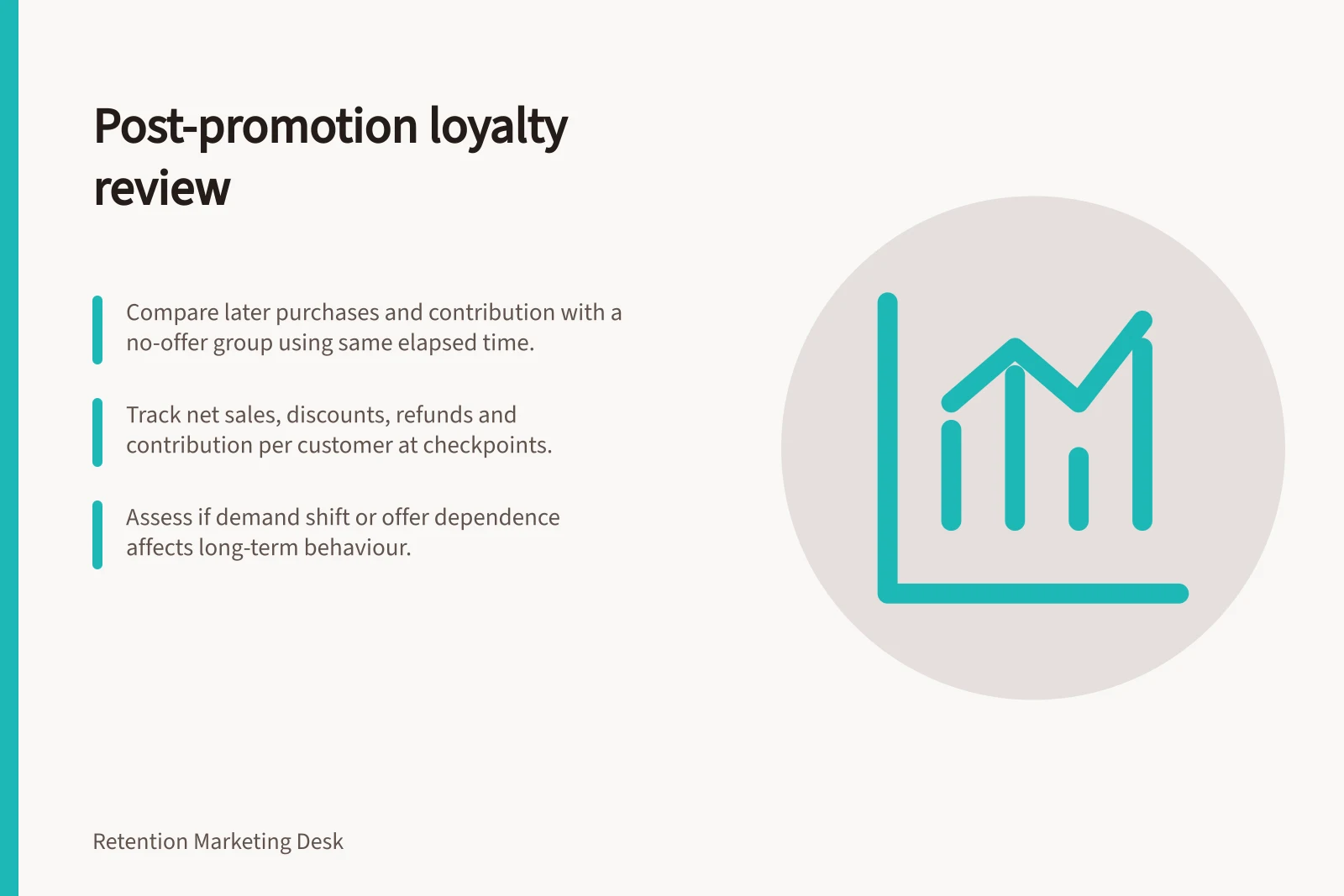
Review a retention promotion after customers have had a reasonable chance to buy again at the regular price. The first discounted order is only the start of the assessment. Compare later purchases and contribution with a comparable group that did not receive the targeted offer, using the same elapsed time.
Preserve the comparison
Before launch, record eligibility, assignment date, offer terms, other planned marketing and the product's usual buying rhythm. Random assignment to an offer and a no-offer group gives a stronger comparison when feasible. Analyse customers in their assigned groups even if they never open the message or redeem the code. Comparing redeemers with everyone else selects people who chose to use the offer.
Apply the same start-date rule and follow-up length to both groups. Customers enrolled later have had less time to buy again; do not treat incomplete histories as mature ones. Include returns and cancellations after the original order as well as new purchases.
Long-term purchase behaviour: Offer group vs. no-offer group
- Eligibility criteria
- Pre-defined based on customer segment and purchase history
- Assignment method
- Random assignment to offer or control group
- Promotion period
- Defined start and end dates aligned with campaign
Track what happens after the sale
At agreed checkpoints, show cumulative purchasers, completed orders, net sales, discounts, refunds and contribution per assigned customer. Include purchases made without a code and show regular-price orders separately. Ask whether a lift during the promotion remains after the next plausible buying opportunity.
A promotion can shift demand in time. A customer who buys extra units of a storable product during a sale may need less soon afterwards. Review quantity and the next purchase interval before treating a later lull as lost loyalty. An order record does not show when the customer consumes the goods.
Look for changes in product mix and offer dependence. Did customers buy only the reduced item, or also other products? Did later orders use another code?
Did basket value rise while contribution fell? These are questions for the retailer's own data, not assumed effects of every promotion.
Key checkpoints for tracking post-promotion behaviour
- Promotion launchStart of offer eligibility and messaging
- First follow-up (e.g., 30 days post-sale)Measure initial repeat purchases at regular price
- Second follow-up (e.g., 90 days post-sale)Assess sustained purchasing, basket value, and contribution
- Final review (e.g., 180 days post-sale)Evaluate long-term impact on loyalty and profitability
Post-promotion performance metrics
- Cumulative purchasers (offer group)
- Number of customers who made a full-price order after promotion
- Net sales (post-promotion)
- Total revenue from regular-price orders in the follow-up period
- Contribution per customer
- Net sales minus discounts and refunds, divided by number of customers
- Offer dependence rate
- Percentage of subsequent orders using another discount code
Interpret results cautiously
If the offer group buys more during the campaign but the no-offer group catches up, the offer may have accelerated purchases. If orders remain higher but contribution per assigned customer is lower, the extra volume has not covered the observed cost.
If later regular-price purchasing and contribution are both higher, the promotion may be promising for the tested group and period. Report group sizes and uncertainty before extending that conclusion.
Redemption alone cannot settle these cases. Published field experiments on targeted discount offers have examined effects beyond redemption, but they come from other firms and settings and do not establish what will happen for another retailer. Use the measurement principle without borrowing those results.
Pros and cons of using targeted discounts for retention
- Pros
- Can boost short-term sales and encourage trial; useful for re-engaging inactive customers
- Cons
- May create dependency; can reduce contribution if volume doesn’t offset discount cost
Decide when evidence is mature
Choose the review point from the category's buying interval, then allow for delivery, returns and reporting delay. A consumable and a durable product should not share an arbitrary ‘long-term’ window. If another purchase is rare by nature, report that the evidence is still immature.
Record a decision: continue for the same group, narrow eligibility, reduce the incentive, test a service alternative or stop. Preserve the offer and cost history so the next promotion can be assessed against what customers were already receiving. Monitor complaints and opt-outs alongside commercial outcomes.
Steps to assess retention promotion effectiveness
- Define the review timeline based on product categoryAllow time for delivery, returns, and reporting delays
- Ensure both groups are tracked consistentlyInclude all purchases, returns, and cancellations
- Check for demand shiftingAssess whether purchases were delayed rather than increased
- Report uncertainty and sample sizeAvoid overgeneralising results without statistical confidence
- Record decision for next promotionContinue, narrow eligibility, reduce incentive, test service alternative, or stop