Repeat Purchase
Part of Repeat-purchase economics
Calculating the contribution from returning customers
Identify qualifying repeat orders, subtract relevant variable costs and report observed contribution with its data limits.
To calculate observed contribution from returning customers, identify their qualifying later orders in a fixed period. Calculate contribution for each order on one cost basis, then add the results. Show customer and order counts beside the total. This describes orders that happened; it does not measure what a retention campaign caused.
Set the population
A returning customer can mean someone with any earlier store purchase or someone with an earlier purchase in a relevant product group. Choose the rule before calculating. State the reporting period, the order date used and how much earlier history is available. Limited history can make an established buyer appear new.
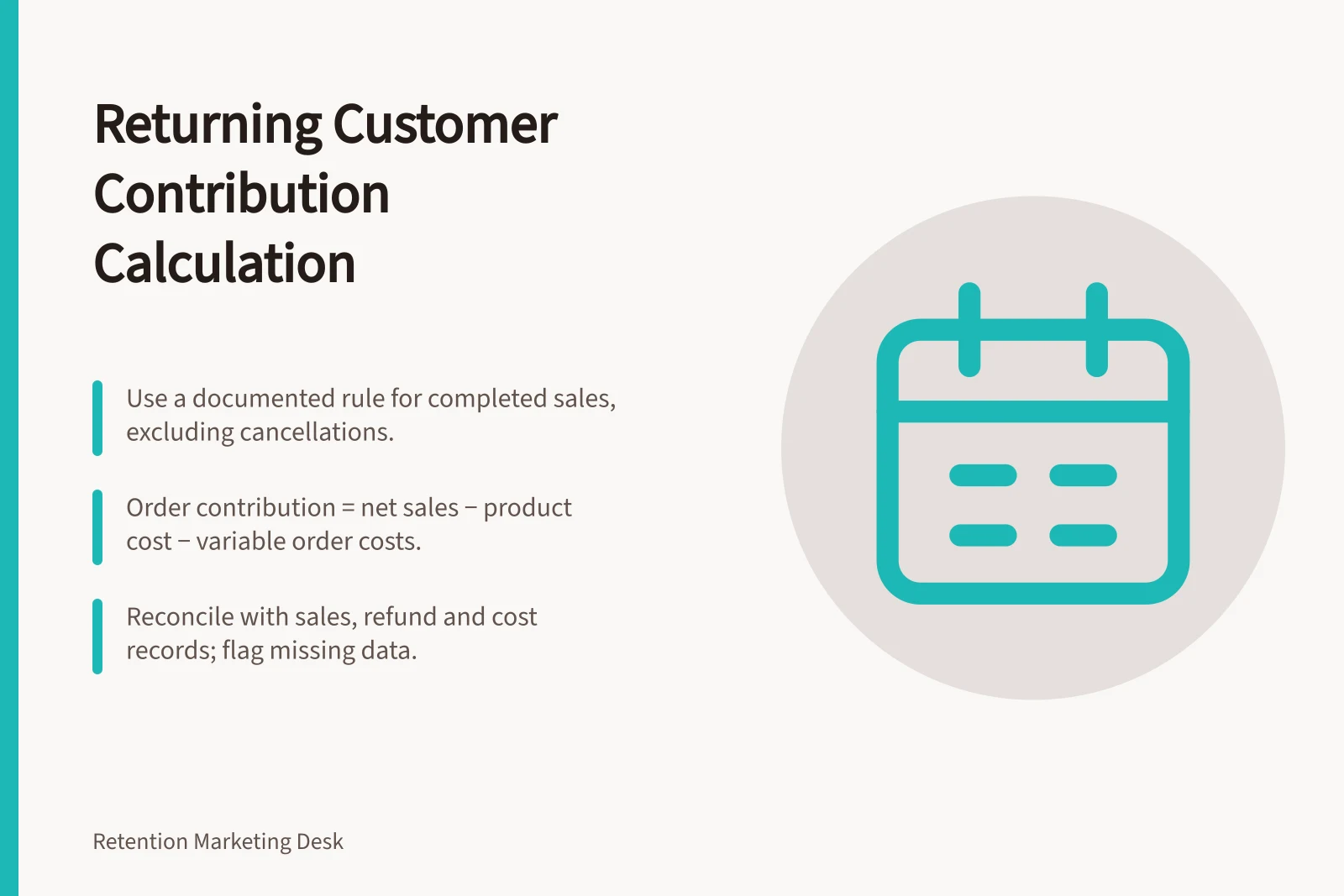
Use a documented rule for completed sales. Exclude cancellations and account for full or partial refunds. Decide whether exchanges, replacement shipments and subscription renewals represent qualifying new demand. If guest and in-store identities cannot be linked confidently online, flag the uncertain records rather than assigning them silently to a new-customer group.
Calculate each order
Order contribution = net sales − product cost − relevant variable order costs.
Net sales should reflect discounts and sales reversals. Relevant variable costs may include packing, fulfilment, payment fees and delivery subsidies. Include any shipping revenue and shipping expense consistently, and use the same tax basis for sales and costs.
For mixed baskets, calculate product costs at line level where possible and document how shared order costs are assigned.
Handle returns consistently. If sale proceeds are reversed but usable stock is recovered, reflect that recovery in the cost calculation; otherwise the refunded order can appear more costly than it was. Flag missing product costs rather than treating them as zero.
| Hypothetical repeat order | Net sales | Product cost | Other variable costs | Contribution |
|---|---|---|---|---|
| Order A | A$120 | A$65 | A$15 | A$40 |
| Order B | A$80 | A$42 | A$12 | A$26 |
| Total | A$200 | A$107 | A$27 | A$66 |
The invented amounts show the arithmetic. If both orders belonged to one person, the period contains one returning customer, two qualifying orders and A$66 of observed contribution. If they belonged to two people, contribution remains A$66 and the customer count is two.
Reconcile and label the result
Compare the qualifying order list with sales, refund and cost records. Sample cases near the rules: a late refund, an in-store purchase, a replacement and a mixed basket. Explain material differences from a platform report.
Report total contribution and, where useful, contribution per returning customer and per qualifying order. If costs are incomplete, use a narrower label such as “net sales less recorded product cost” and list the omissions. Do not call the result net profit or campaign uplift.