Repeat Purchase
Calculating the contribution from returning customers
Identify qualifying repeat orders, subtract relevant variable costs and report observed contribution with its data limits.
Desk
Follows the campaigns and journeys designed to bring customers back or increase frequency.
Repeat Purchase
Identify qualifying repeat orders, subtract relevant variable costs and report observed contribution with its data limits.
Win-Back Campaigns
Assess Australian consumer rights first, then decide whether an additional gesture addresses remaining inconvenience.
Repeat Purchase
Choose a category-appropriate repeat-purchase metric with a clear numerator, eligible customer group, purchase definition and follow-up window.
Win-Back Campaigns
Use order, service and customer evidence to choose a win-back response, resolve owed remedies and check discretionary incentives.
Repeat Purchase
Choose accurate setup, care, service and compatibility help that supports owners of durable products after purchase.
Win-Back Campaigns
Design a fair reminder versus incentive test and judge what the offer adds after its cost.
Win-Back Campaigns
Decide whether a proposed segment recovery action can cover its full cost, and when to narrow, change or stop it.
Repeat Purchase
Separate post-purchase interactions, genuine buying opportunities, observed sales and conditional revenue forecasts.
Repeat Purchase
Avoid treating every one-time gift purchase as the beginning of a replenishment or repeat-buying cycle.
Repeat Purchase
Use comparable repeat purchases to estimate a reorder window, while accounting for pack size, sparse histories and buyers who have not reordered.
Repeat Purchase
Adjust replenishment timing for multi-unit orders without assuming every extra unit extends supply. Check packs, returns and later purchases first.
Win-Back Campaigns
Set a product-specific win-back boundary from purchase gaps, audit cases near it and separate candidates from customers eligible for contact.
Repeat Purchase
Separate recommendation intent, sharing, referred enquiries and completed sales when existing customers rarely repurchase.
Win-Back Campaigns
Define first return, later repeat purchase and contribution per assigned customer to assess recovery after a win-back discount.
Repeat Purchase
Use a no-reminder control and complete order contribution to see whether replenishment messages add profitable repeat purchases.
Retention Operations
Set useful activity, capacity and review targets for durable-product customers without forcing short-term repeat sales.
Win-Back Campaigns
Build an explainable offer-decision record with the eligibility rule, send checks, offer version and actual outcome.
Repeat Purchase
Plan replenishment reminders around likely need, check eligibility before sending, and measure whether they add profitable repeat purchases.
Repeat Purchase
Look beyond the first discounted order to compare later full-price purchases, order timing and contribution.
Repeat Purchase
Keep one-time repeat orders, successful renewals, active subscriptions and prepaid fulfilments distinct in retention reporting.
Repeat Purchase
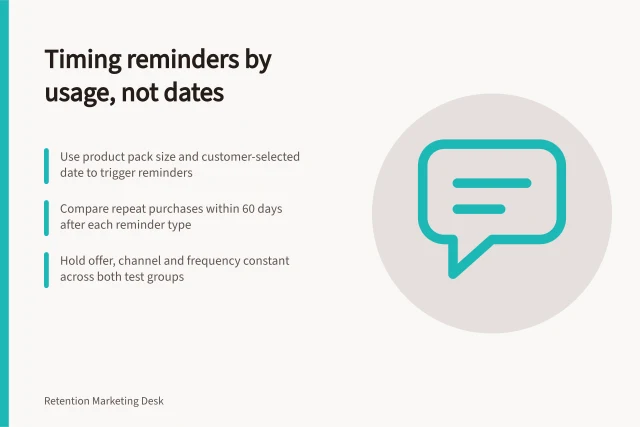
Design a fair test of product-informed reminder timing versus a fixed delay, with consistent eligibility, suppression and outcome windows.
Win-Back Campaigns
Plan a win-back campaign around buying opportunities, relevant responses, Australian messaging requirements and profitable return behaviour.