Retention Economics
Part of Repeat-purchase economics
Estimating customer value with explicit assumptions
Forecast future customer contribution with a stated horizon, cost definition, order assumptions and sensitivity cases.
Estimate customer value by forecasting future contribution for a defined group over a stated period, and show the assumptions behind it. Past spend can inform a forecast; it is not future value. Where customers can stop ordering without cancelling, the point at which they become inactive is usually unknown.
Define the value needed
Start with the decision. A forecast of future repeat-order contribution for first-time refill buyers can inform an onboarding proposal. A forecast for established buyers, or one including the first order, answers a different question. Specify the starting group, products, channels, observation date and forecast horizon.
State whether the figure includes the first order, acquisition cost, retention spending and any discounting of later cash flows. If it excludes those items, use a bounded label such as “forecast repeat-order contribution before retention costs”. A revenue projection is not profit.
Specify these before estimating customer value
- Starting group
- Products
- Channels
- Observation date
- Forecast horizon
- Whether the figure includes the first order
- Whether acquisition cost is included
- Whether retention spending is included
- Whether later cash flows are discounted
Forecast orders and contribution
Estimate qualifying future orders per starting customer in each period, including customers who never order again. Multiply by expected contribution per order for that period, then sum the periods. Avoid estimating only from people who returned: they are a selected group.
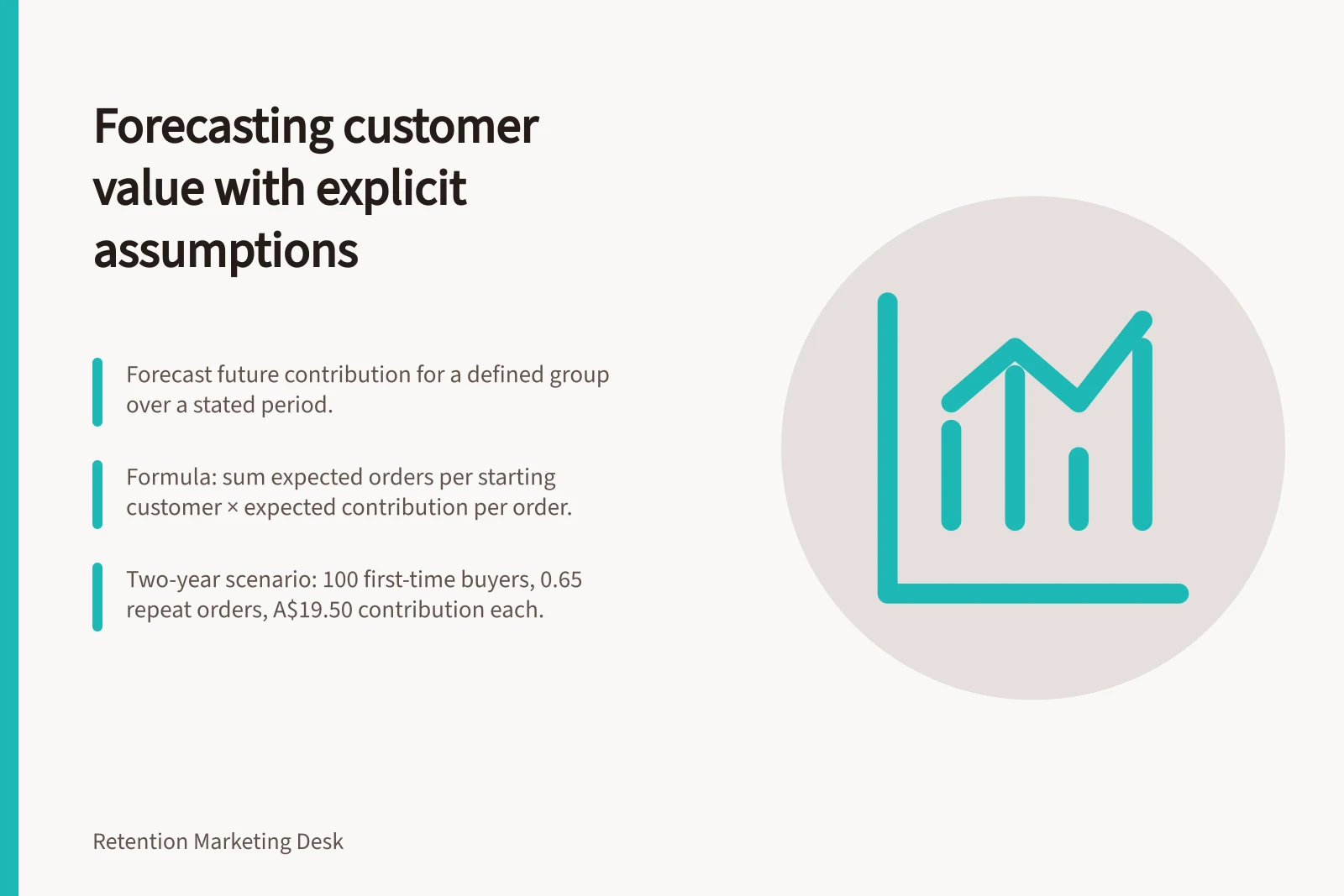
Forecast contribution per starting customer = sum, across future periods, of expected qualifying orders per starting customer × expected contribution per order.
This hypothetical two-year scenario starts with 100 first-time buyers. Its order expectations and costs are invented, not observed rates or benchmarks.
| Future period | Expected repeat orders per original buyer | Assumed contribution per order | Forecast contribution per original buyer |
|---|---|---|---|
| Year 1 | 0.40 | A$30 | A$12.00 |
| Year 2 | 0.25 | A$30 | A$7.50 |
| Two-year total | 0.65 | — | A$19.50 |
That is A$1,950 across the 100 starting buyers before retention spending. It does not predict that each person makes 0.65 orders; some may make none and others several. First-order contribution and any period after year two are excluded.
How to forecast contribution per starting customer
- Estimate expected qualifying future ordersPer starting customer in each period, including customers who never order again.
- Multiply by expected contribution per orderFor that period.
- Sum across future periodsGives the forecast contribution per starting customer.
Show what could change the answer
Record assumptions about the share who return, order frequency, basket mix, prices, discounts, refunds and variable costs. Check whether the histories used to set those assumptions have enough follow-up and cover relevant sales channels. Buying season or a change in pack size can weaken a simple historical average.
Keep A$30 contribution per order but assume 0.30 orders in year one and 0.15 in year two: the two-year figure becomes A$13.50 per starting buyer. At 0.50 and 0.35 orders, it becomes A$25.50.
These invented cases show sensitivity; they are not confidence intervals. If the spending decision changes across plausible cases, the central A$19.50 figure is too uncertain to use as a precise entitlement.
For a longer horizon, state whether later amounts are discounted and at what rate. With sparse records, a shorter horizon may be more defensible. Compare the forecast with later customer groups once enough time has passed, and record changes to the assumptions.
Forecast customer contribution is not the contribution a campaign creates. The latter requires an estimate of what the proposed action adds against the usual alternative.