Retention Economics
Part of Retention investment decisions
Comparing acquisition expansion with retention improvement
Compare the next acquisition and retention investments using incremental contribution, full costs and a shared decision horizon.
Compare the next increment of acquisition spending with the next increment of retention spending over the same decision horizon. The question is what each additional dollar is likely to change after relevant costs, not whether acquiring or retaining customers is generally better.
Define the two marginal options
Specify an actual change for each side. “Increase acquisition” might mean adding spend to one eligible campaign while keeping its current activity running. “Improve retention” might mean repairing a reorder obstacle for a defined product group. Compare each proposal with what would happen if that extra work were not funded.
Do not compare all historical acquisition cost with the price of one retention email. Earlier spending built the existing customer base; it does not become a saving when a new retention action is approved. Equally, a cheap email is not an economic win if it adds no purchasing or discounts orders that would have happened anyway.
Use a common commercial unit
For both options, forecast additional order contribution before the option's additional costs over a stated period, then subtract those costs. Count completed orders after discounts and refunds, then subtract product cost and relevant variable order costs.
Add media, creative, staff, service and system costs that change because of the option. Allocate shared costs consistently and do not subtract the same incentive twice.
| Acquisition expansion | Retention improvement |
|---|---|
| Estimate additional first-time buyers caused by the extra activity. | Estimate additional existing buyers or orders caused by the change. |
| Include their first-order contribution and any defensible later contribution within the chosen horizon. | Include contribution from extra later orders within that horizon. |
| Subtract additional media, creative and operating costs. | Subtract repair, contact, incentive and operating costs that the change adds, unless already included in order contribution. |
For acquisition, report the extra buyer count separately from conversion events or attributed orders. For retention, count all eligible customers when reporting the effect per customer, including those who would return anyway and those who do not buy. A customer-value forecast can inform either side, but future orders remain assumptions until observed.
Check the evidence behind each increment
As spending expands, the customers reached and the cost of reaching them may differ from the original campaign. Do not extend an earlier average return mechanically to the next spend level. Similarly, a retention pilot involving easy-to-reach customers may overstate what a broader rollout can deliver. State the audience and capacity limit for each estimate.
Where feasible, compare incremental advertising against a suitable unexposed group or market. Whether such a comparison is available and fits this decision must be checked in the advertising account. A retention change needs its own suitable usual-treatment comparison. The two estimates may have different precision; show that difference in the decision sheet.
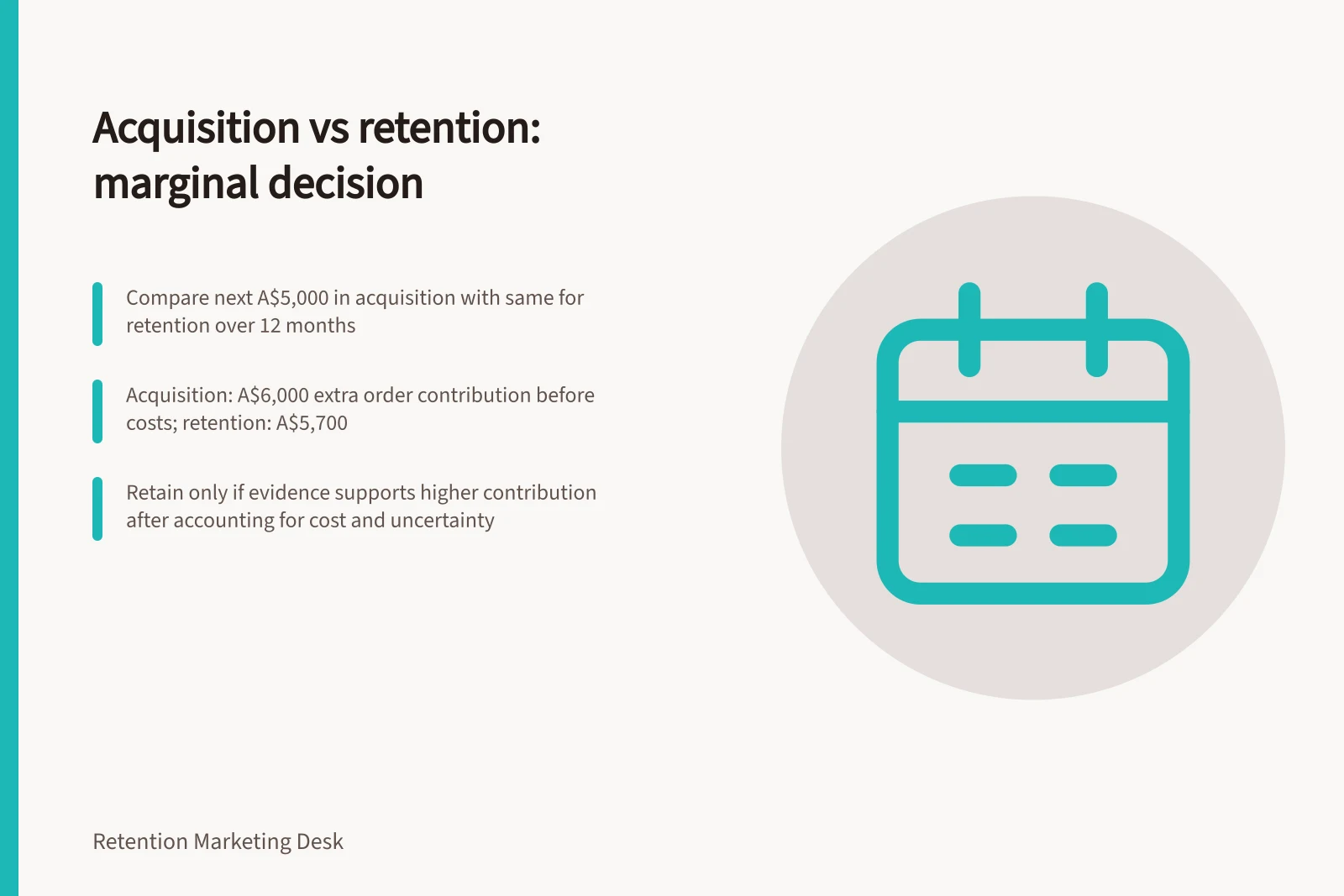
A hypothetical planning comparison makes the arithmetic clear. Suppose an extra A$5,000 in acquisition activity is assumed to create A$6,000 in additional order contribution before that spending over twelve months. Suppose an A$5,000 retention improvement is assumed to create A$5,700 on the same basis.
Their provisional gains are A$1,000 and A$700. These invented figures are assumptions, not test results. If the acquisition contribution estimate could plausibly fall below A$5,000 while the retention estimate is better supported, a simple A$1,000 versus A$700 ranking hides the decisive uncertainty.
Choose the next spend, then measure it
Record the horizon, audience, incremental assumption, cost basis, uncertainty and operational constraint for each option. Fund the stronger evidenced next increment, split a limited budget when learning from both options is valuable, or postpone expansion until a critical input can be checked. Revisit the comparison after the extra spend and a fair buying window. The answer can change at the next increment.