Win-Back Campaigns
Part of Retention investment decisions
Deciding when a customer segment is uneconomical to recover
Decide whether a proposed segment recovery action can cover its full cost, and when to narrow, change or stop it.
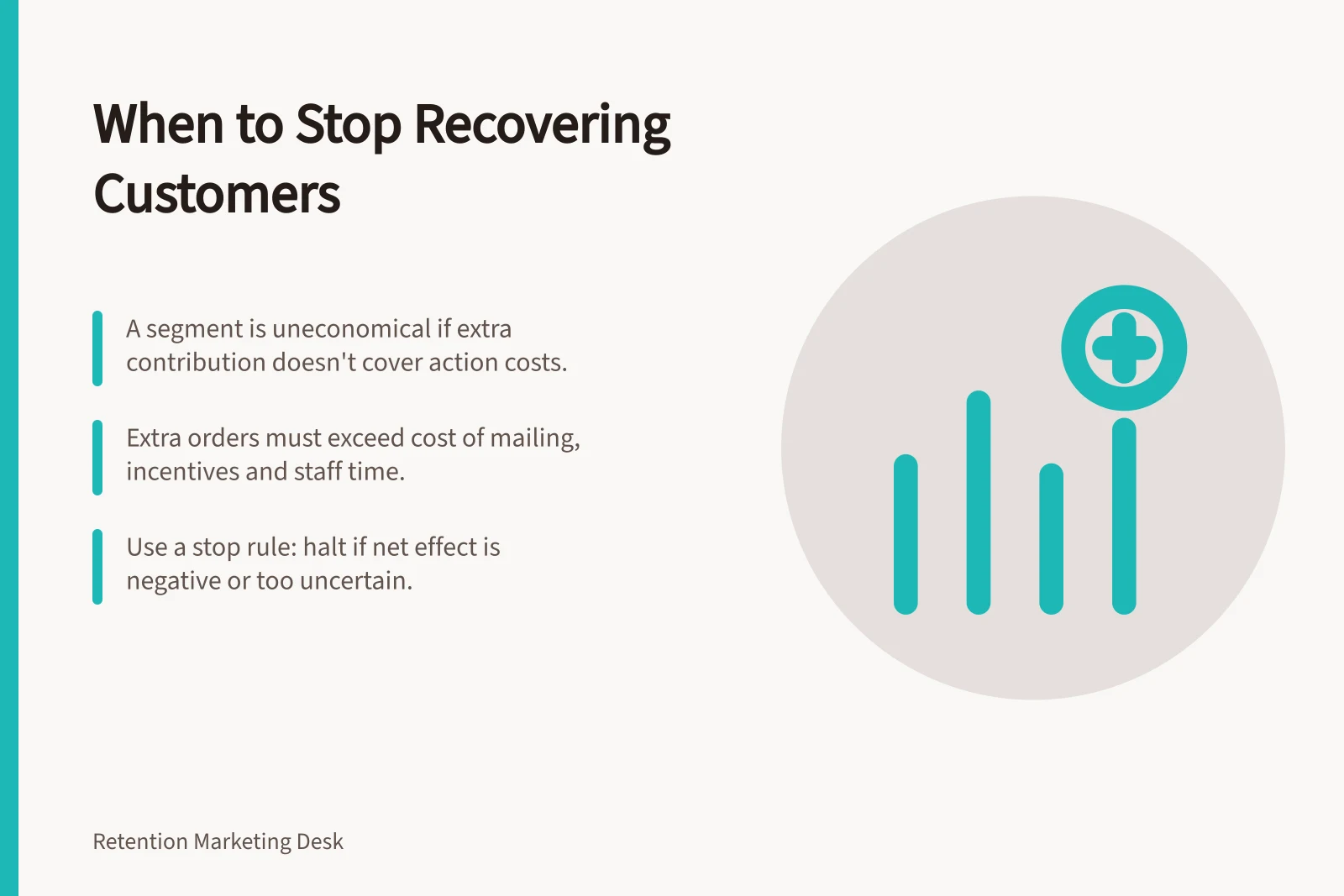
A customer segment is uneconomical to recover through a proposed discretionary action when the additional contribution it is likely to produce does not cover that action's additional cost at an acceptable level of uncertainty. Make that judgement for a defined segment, action and buying window. High past spending, a large mailing list or positive contribution on redeemed orders cannot settle it.
Define the recoverable segment
Specify the relevant earlier purchase, the normal opportunity to buy again and the rule making a customer eligible. Resolve duplicate identities where possible and distinguish a returned or cancelled order from fresh demand. Keep customers with uncertain purchase history in a separate group. A segment built only from days since last order may contain buyers who have not needed another product yet.
Then describe the proposed action. A service follow-up, a reorder reminder and a discount have different costs and possible effects. State what eligible customers would receive without the new action. That usual treatment is the basis for comparison.
Count all eligible customers and all costs
Estimate additional completed orders caused by the action, including orders placed without a code. Calculate contribution after discounts, refunds, product cost and relevant variable costs. Include sending, staff, fulfilment, set-up and incentive costs where they change, counting each cost once. Include fixed costs for the intended eligible group and people who never respond.
Provisional net effect = extra order contribution across the eligible segment − extra program costs not already counted.
For illustration only, suppose a proposed contact to 100 customers costs A$100 and is assumed to add five orders contributing A$25 each after any incentive. Its provisional net effect is A$25. If it adds only two such orders, the result is negative A$50. These are invented scenarios, not a retailer test. They show why assumed incremental orders and uncertainty matter more than redemptions.
A discount can leave each redeemed order with positive contribution yet lower contribution for the whole group if many recipients would have bought at the regular price. If the estimated benefit depends on perfect targeting or an implausibly high response, narrow the segment or change the action before approval.
Consider a lower-cost route before stopping
“Uneconomical to recover” applies to the proposed discretionary route, not to the customer as a person. A broad discount may fail while accurate stock information or an easier reorder route could be useful at lower cost. Separate customers whose need has ended from those facing a fixable barrier where the evidence allows. Keep the reason unknown when it does not.
This decision concerns optional recovery spending. Consumer-guarantee questions are separate. The ACCC educates consumers about their rights and responsibilities under the consumer guarantees and accepts reports about possible business conduct it can investigate. It does not resolve individual disputes or give legal advice about a consumer's right to a repair, replacement or refund for a faulty product or service.
Pros and Cons of Discount-Based Recovery vs. Low-Cost Alternatives
- Discount-Based RecoveryPros: May drive immediate response; Cons: Risk of eroding margins if non-targeted buyers redeem; Can lead to lower overall contribution even if individual orders are profitable
- Low-Cost Alternatives (e.g., stock info, easier reorder)Pros: Lower cost; More targeted; Less risk of margin erosion; Better alignment with customer need; Cons: May not generate as many responses if demand is low
Set a stop rule and learn from it
Where feasible, compare the proposed action with usual treatment for the same eligible population over a fair buying window. Analyse everyone assigned, including non-buyers. Record group sizes, cost coverage, relevant orders, contribution per eligible customer and uncertainty. A small positive estimate may be too fragile to justify wider rollout.
Choose a rule before launch: continue if added contribution clears the required margin after cost, narrow to a segment with a credible barrier, test a cheaper response, or stop discretionary contact. Review complaints and opt-outs as well as orders. If another purchase opportunity is rare, report the commercial result as immature.