
Win-Back Campaigns
Part of Retention after a bad customer experience
Choosing a remedy proportional to the customer problem
Assess Australian consumer rights first, then decide whether an additional gesture addresses remaining inconvenience.
First identify the remedy required under the Australian Consumer Law (ACL); only then consider a discretionary gesture for any remaining inconvenience. For a product or service, the failure and whether it can be fixed easily and within a reasonable time help determine the legal remedy. Any extra offer should address a real burden the remedy has not addressed.
Separate the obligation from the gesture
The ACL sets consumer guarantees for goods and services. A business must meet those guarantees; a store policy or extra gesture does not replace an applicable legal remedy.
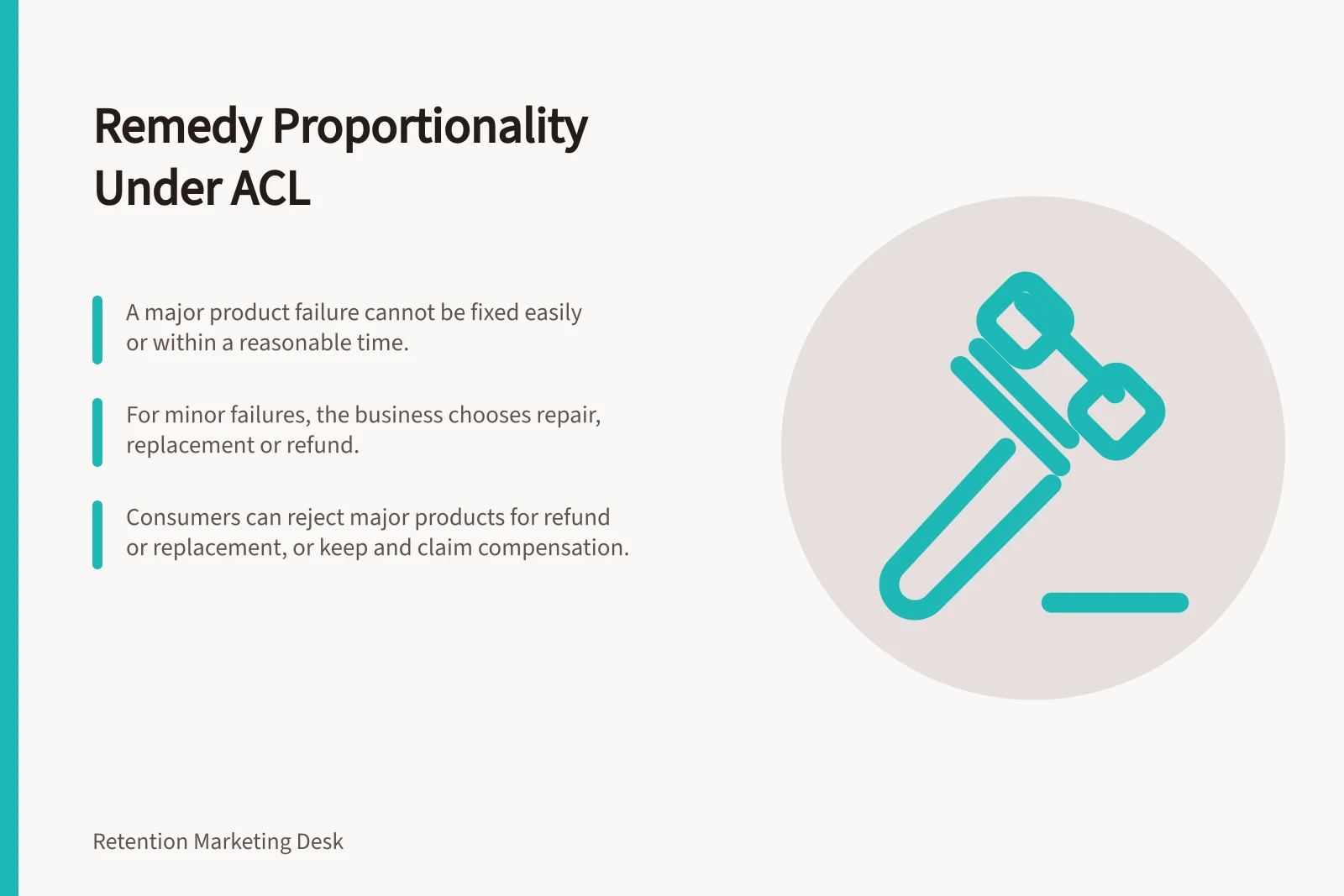
For a product that fails to do an agreed specific job or purpose, the failure is major if it cannot be fixed easily and within a reasonable time. If it can be fixed easily and within a reasonable time, it is minor. The reasonable time depends on the goods: a two-week wait for clothing or shoes to be repaired may be reasonable, while a month for a fridge or washing machine may not be.
For a minor product failure, the business chooses whether to provide a free repair, replacement or refund. For a major product failure, the consumer can reject the product and choose a refund or replacement, or keep it and receive compensation for any drop in value.
For a minor service failure, the business chooses whether to repair it for free or give a refund. For a major failure, or one that cannot be fixed, the consumer can cancel the contract and get their money back, or continue the service at a lower price.
Clarify the problem, the promise made and the effect on use or safety before agreeing a solution. The ACCC educates consumers, accepts reports and may investigate misleading claims about rights or payment accepted without intending to supply; it does not resolve individual disputes or give legal advice. State and territory consumer protection agencies manage individual complaints and may offer voluntary dispute services; courts and tribunals can enforce the ACL.
Match the response to the problem
| Situation to assess | Immediate question | Remedy or next response |
|---|---|---|
| Product failure | Is it major, or can it be fixed easily and within a reasonable time? | Minor: the business chooses a free repair, replacement or refund. Major: the consumer can reject it for a refund or replacement, or keep it and receive compensation for a drop in value. |
| Service failure | Is it minor, major or unable to be fixed? | Minor: the business chooses a free repair or refund. Major or unable to be fixed: the consumer can cancel the contract and get their money back, or continue at a lower price. |
| Paid-for order not supplied on time or within a reasonable time | What was promised, and what can now be supplied? | Give an accurate update and a solution suited to the circumstances. If no timeframe was agreed for a service, it must be supplied within a reasonable time. |
| Agreed remedy still pending | What has actually been completed? | Give an owner and next update; keep the case open. |
| Remedy complete but inconvenience remains | What extra burden did the customer face? | Consider a useful discretionary gesture without presenting it as the legal remedy. |
For example, consider the silver toaster described as expected to toast bread. If it does not toast, assess whether that failure can be fixed easily and within a reasonable time: if it can, the failure is minor and the business chooses the remedy; if it cannot, the consumer has the choices for a major failure. A late order and a faulty product raise different questions, and one case may involve both.
Decide whether an extra gesture helps
Once the required remedy is clear, consider the time, cost or disruption that remains. Practical assistance or a credit may help if it addresses that burden; a future-purchase coupon may be of little use to someone who does not want to order again.
Do not assume a proposed payment or cost reimbursement is discretionary goodwill: first establish whether it forms part of the applicable remedy. An extra benefit must not be a condition of receiving an owed remedy.
Give unusual cases an approval route and state any conditions on an extra benefit clearly. The service owner should be able to explain what has been agreed and when the next action will happen; do not promise unconfirmed dispatch, settlement or availability.
Verify the result
Record the remedy, the reason for choosing it, the owner and evidence of completion. Confirm receipt or effectiveness where appropriate; if a replacement has not arrived or a repair has failed, reassess the problem rather than closing the case because a gesture was issued.
Apply the same questions to comparable cases, while allowing outcomes to differ with the facts and the consumer’s applicable choice.


