Win-Back Campaigns
Part of Retention experimentation
Comparing a reminder with an incentive
Design a fair reminder versus incentive test and judge what the offer adds after its cost.
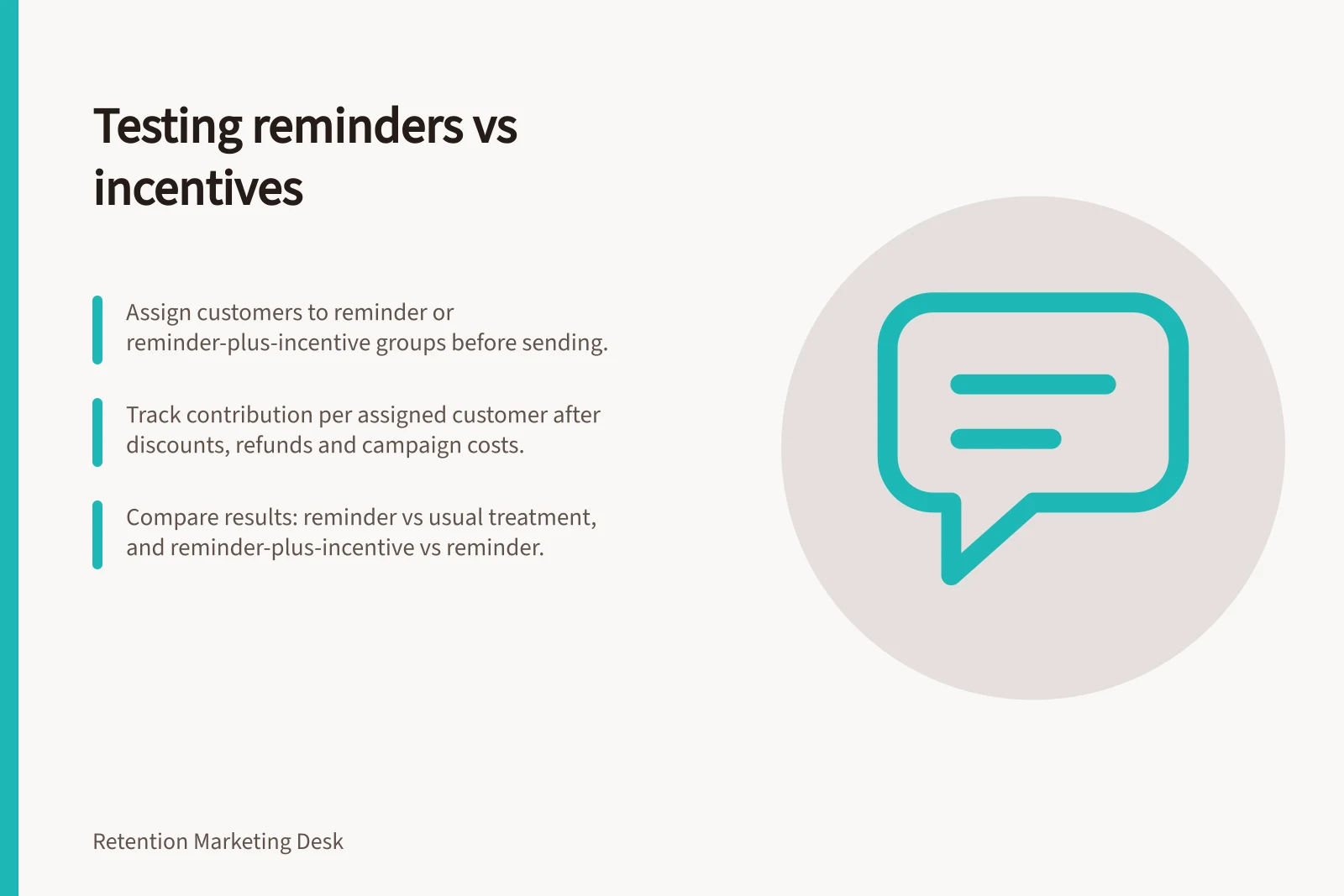
Randomly assign comparable eligible customers to the same core reminder, with or without the offer, to learn what an incentive adds. Judge the difference after the offer's cost.
A third group receiving usual treatment can show whether either message improves on the existing approach.
Keep the comparison clear
Choose customers and products with a plausible reason to buy again. Define a relevant completed purchase and check for an order already placed before assignment.
Keep the channel, timing, product, frequency and main reorder route as similar as practical between the two messages.
State the offer terms clearly in the incentive version. If that version also changes several other elements, the result measures the whole revised message rather than the price benefit alone.
| Assigned group | Treatment | Decision it supports |
|---|---|---|
| Usual treatment | Existing service and marketing, without the new message | Does the proposed campaign improve on current practice? |
| Reminder | New reminder without a targeted incentive | What does the reminder add? |
| Reminder plus incentive | Same core reminder with a defined benefit | What does the benefit add to the reminder? |
If only two informative groups are feasible, choose the contrast needed for the immediate decision. Reminder versus reminder plus incentive compares those messages, but cannot establish whether either beats usual treatment.
Specify the offer and its cost
Record eligible products, benefit, expiry, maximum value and stacking rules. Check the intended checkout outcome before sending.
The ACCC can require businesses to back up claims they make about their products or services. Keep material exclusions clear so customers can understand what is included. Resolve an outstanding service remedy separately from this discretionary offer.
A discount reduces contribution on redeemed orders, including some purchases that would have occurred after a reminder alone. Include any extra delivery subsidy, reward or contact cost, counting each cost once. More orders need not mean more contribution.
Apply the same contact-eligibility and suppression rules to both message groups, and check applicable requirements before sending promotional email or SMS.
Compare everyone assigned
Assign customers before the first send and keep each person in their group. Use a common follow-up window long enough to observe a plausible reorder after the offer expires. Count purchases made without a code and include customers who never open or redeem in the assigned-group result.
Show completed purchasers and orders, then compare contribution per assigned customer where costs are reliable. For each group, total sales after discounts and refunds, subtract product and relevant variable costs plus campaign costs, and divide by all customers assigned. If material costs are missing, label the narrower measure and list its omissions.
Read the contrasts separately. Reminder versus usual treatment estimates the reminder's added effect. Reminder plus incentive versus reminder estimates what adding the offer changes. Reminder plus incentive versus usual treatment estimates the package effect.
Report group sizes, the follow-up dates and uncertainty for each contrast. Review later quantities and regular-price purchases to see whether an early lift may have brought orders forward.