Retention Operations
Retention after a bad customer experience
Resolve a poor customer experience, confirm the remedy, pause unsuitable promotions and assess what happened afterwards.
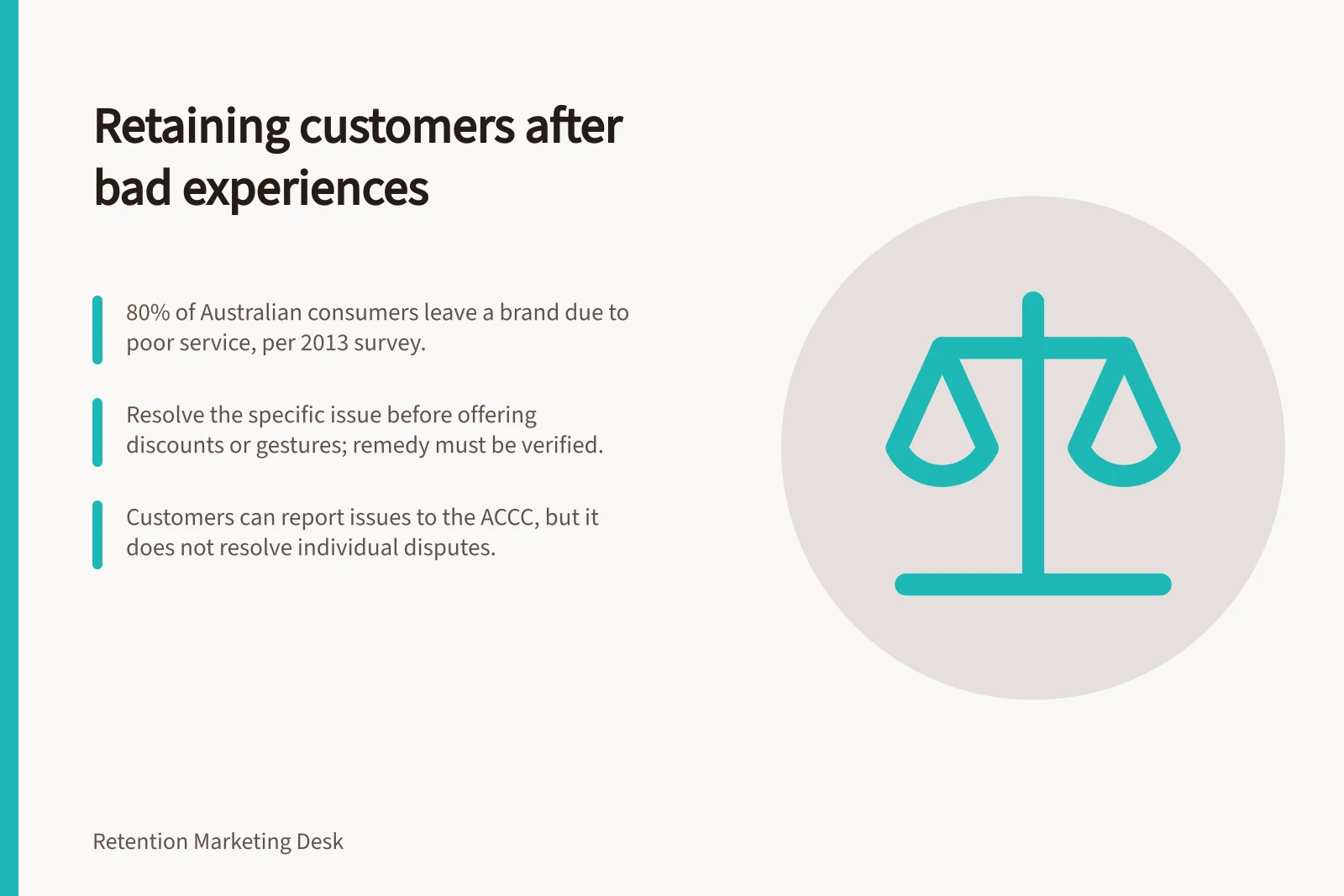
To retain a customer after a bad experience, resolve the specific problem, verify the agreed remedy was completed, then ask whether anything remains wrong. An apology or discount cannot establish that the customer trusts the business again.
Treat retention as a risk, not a promised outcome
A 2013 survey of 1,114 Australian consumers aged over 18, reported by SmartCompany and attributed to Feedback ASAP, found 80% said poor customer service influenced their decision to leave a brand. In the same survey, 92% said customer service was a key factor in remaining loyal.
Key Consumer Loyalty Statistics in Australia
- Percentage influenced by poor service
- 80%
- ACCC enforcement focus
- Consumer guarantees under Australian Consumer Law
Treat the incident as a service case first
Build a short timeline: what was promised, what happened, what the customer reported, what was offered and what remains outstanding. Read the order record alongside the customer's account. A delivery scan does not establish that the contents arrived intact; a closed ticket does not establish that the remedy reached the customer.
Give the case an owner and a date for the next update. If a carrier, supplier or repairer is involved, explain what is known and what remains uncertain. Do not promise a dispatch or refund date before the responsible team confirms it.
Establish the remedy before adding a gesture
For an Australian purchase, check whether consumer guarantees may apply.
Separate the agreed remedy from an optional gesture. A credit may recognise inconvenience after the underlying issue is addressed, but it should not be presented as the solution to a faulty or undelivered purchase. Ask what outcome the customer needs before assuming another order would help.
Know what external reporting can do
If a customer remains concerned about their consumer rights, explain they can report a consumer issue to the ACCC. The ACCC educates consumers about their rights and responsibilities under the consumer guarantees, and educates consumers and businesses about their rights and responsibilities under consumer law.
It uses reports to inform its education, compliance and enforcement work.
The ACCC does not resolve individual disputes or give legal advice about a customer's right to a repair, replacement or refund for a faulty product or service. It also does not resolve individual disputes about a failure to supply or delayed supply.
Reporting may inform the ACCC's work, but it is not a substitute for completing the business's own case handling.
Pros and Cons of Reporting to the ACCC
- ProsHelps inform ACCC education, compliance, and enforcement efforts; empowers consumers with knowledge of their rights.
- ConsDoes not resolve individual disputes; no legal advice provided; not a substitute for internal case handling.
Follow through on the agreed action
Use evidence that matches the remedy: a refund processed, a replacement received, a repair completed or a missing item delivered. Keep a case pending while the action is still in transit.
A brief follow-up can ask whether the agreed outcome was received and whether anything remains wrong. Make it easy to reopen the case without repeating the whole account.
“We have arranged the replacement and will update you when dispatch is confirmed” does not claim it is already on its way. If the customer reports an unresolved problem, return it to service.
Keep promotion out of the active case
Avoid promotional contact while a service case is open.
Assess the outcome without claiming to measure a feeling
Remedy completion, customer feedback and later purchasing answer different questions. A completed action shows what the business did. Feedback gives a respondent's view at that time.
A later purchase shows a choice to buy, but may reflect convenience, price or another need. None alone proves restored trust.
For this recovery flow, record whether the agreed remedy was completed and whether the customer reports anything remains wrong.
If the same failure recurs, pass the documented pattern to the team able to fix its cause.
In this guide
- Following up after a delayed or damaged orderVerify a delayed or damaged order, give an accurate update, arrange the appropriate solution and confirm the outcome.
- Measuring whether a resolved complaint restored trustSeparate remedy completion, customer feedback and later purchasing to assess a resolved complaint without overstating the result.
- Choosing a remedy proportional to the customer problemAssess Australian consumer rights first, then decide whether an additional gesture addresses remaining inconvenience.
- Avoiding promotional messages before a service problem is resolvedSet a service-case promotion hold, recheck it near sending and release it after the agreed remedy is complete.