Retention Economics
Part of Discounting and customer retention
Limiting retention offers by actual margin
Calculate a practical offer ceiling from order contribution, then check discounts, stacking, refunds and incremental value.
Set a retention-offer limit from the contribution an eligible order can earn after the incentive and its variable costs. A discount small against the selling price may consume most of what remains after product, fulfilment and payment costs.
Calculate the limit for eligible products and baskets. Review realised results after refunds and other adjustments.
Build the cost view
Start with expected order value before the incentive, net of expected refunds. Use one consistent tax and expected-return basis. Subtract product cost and order-variable costs: packing, fulfilment, payment, delivery subsidies and offer-specific rewards.
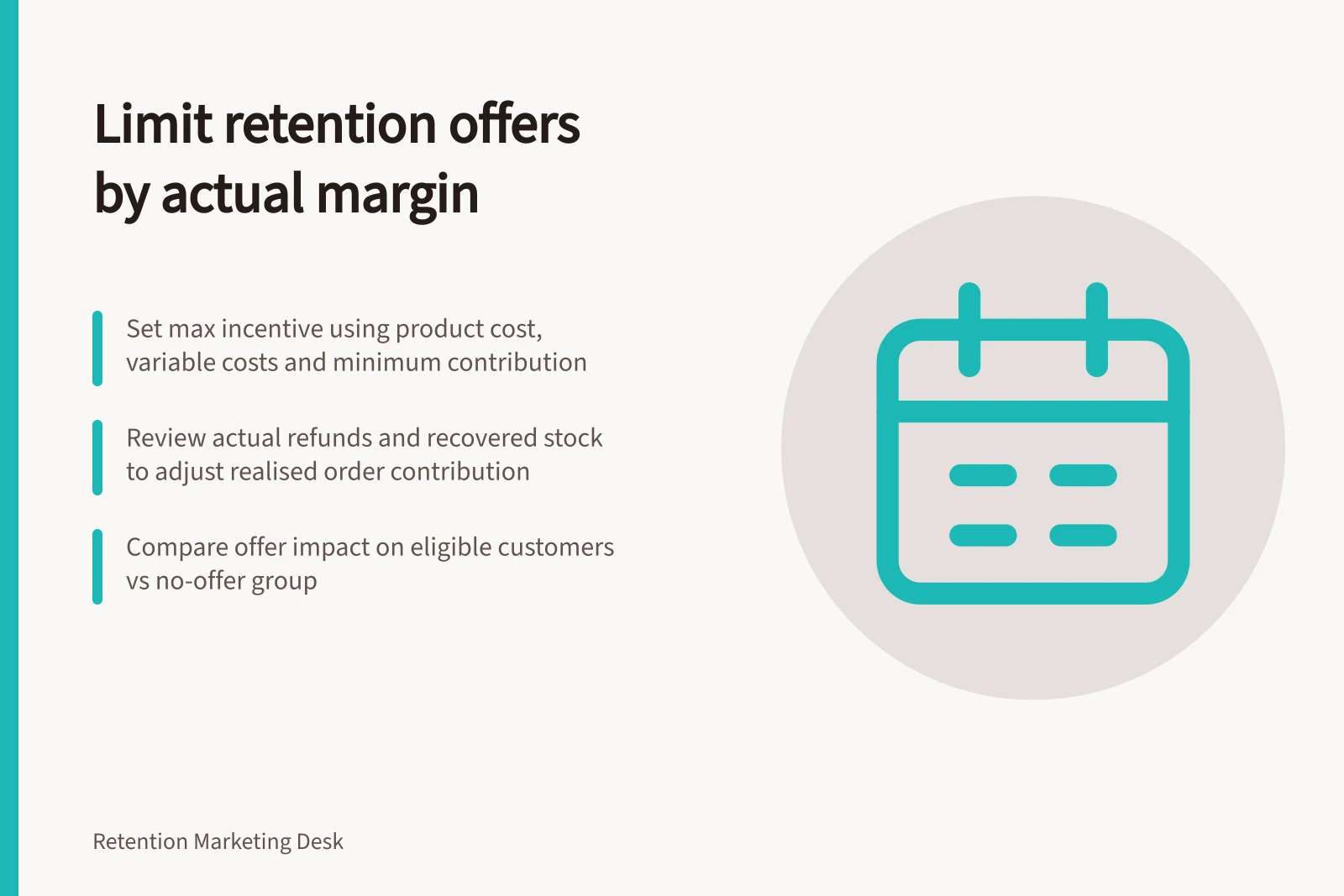
When reviewing completed orders, replace estimates with actual refunds and costs where available. Treat returned goods consistently: do not subtract the full original product cost if usable stock is recovered and the calculation credits that recovery.
If using a platform margin report, check which sales, product costs and adjustments it includes. Compare those figures with the variable costs relevant to this offer.
Do not approve an automatic offer on a basket whose material costs are missing.
Set the ceiling before choosing the code
A simple screening calculation is: Maximum incentive = expected order value before the incentive − product cost − relevant variable costs − minimum acceptable contribution.
Apply one consistent treatment for other discounts: include them in the starting sales value or subtract them separately, but never both. Treat free delivery, bonus points and gifts as benefits with a cost. If offers can stack, calculate their combined exposure. Check the lowest-contribution eligible basket as well as the average, and exclude products for which the calculation cannot support the proposed offer.
For an illustrative order, take A$100 as the value before the offer, A$55 product cost and A$15 other relevant variable costs, all on a consistent basis. Contribution before the offer is A$30. An A$10 reduction leaves A$20 before any additional campaign cost or later adjustment. The amounts demonstrate the arithmetic; they are not a recommended discount.
The minimum acceptable contribution is a business decision. Record its rationale before launch. Do not rely on predicted lifetime value to excuse a loss without making its assumptions and uncertainty explicit.
Separate order viability from incremental value
An offer can pass the order-level ceiling and still lose money overall. If a customer would have made the same purchase at the regular price, the discount reduces contribution. Extra orders must cover incentives given both to persuaded buyers and to those who would have purchased anyway.
Compare contribution per eligible customer with a no-offer group over the same period. Include customers who did not buy, together with applicable costs and refunds. That answers a different question from whether each redeemed order has positive contribution. Review results by product or offer rule where group sizes permit, without treating a small difference as certain.
Order Viability vs Incremental Value: Key Distinction
- Incremental Contribution (Net of Non-Incentivised Buyers)
- May be negative if offer attracts existing customers
- Key Insight
- An offer can pass the margin check but still reduce overall profitability.
Enforce and review the limit
Specify eligible products, minimum basket, maximum monetary benefit, stacking rule, expiry and exclusions. Recheck the basket at checkout where the system supports it. State the offered price and conditions clearly, and check that savings claims and exclusions do not create a misleading impression.
After launch, compare the planned ceiling with realised order contribution. Pause the rule if missing costs, refunds or stacking make the limit unreliable.