Churn Diagnosis
Part of Discounting and customer retention
Detecting customers trained to wait for a discount
Use purchase and promotion timelines to investigate discount waiting, then test whether another offer adds profitable orders.
Frequent sale purchases do not prove that a customer is waiting for a discount. To investigate, compare purchase dates with promotions, plausible regular-price buying opportunities and the product's normal buying cycle. Treat the result as a pattern to test, not a diagnosis of the customer's motives.
Rebuild the timeline
Place completed purchases beside the prices and offers available at the time. Record the product or a genuine substitute, paid price, discount, quantity, returns and campaign exposure where known. Include the next regular-price period and whether the product was available. Code redemption alone misses purchases influenced by a public sale or a message that did not require a code.
Ask whether another purchase was plausible. Someone who bought a large pack last month may have had no reason to reorder at the regular price. A first-time buyer has no earlier pattern to compare. Separate products with different purchase rhythms and account for seasonal demand before interpreting a quiet interval as waiting.
Reconstructing Customer Purchase and Promotion Timeline
- Promotion Available?
- No
- Product Availability
- Yes
Look for repeated changes in timing
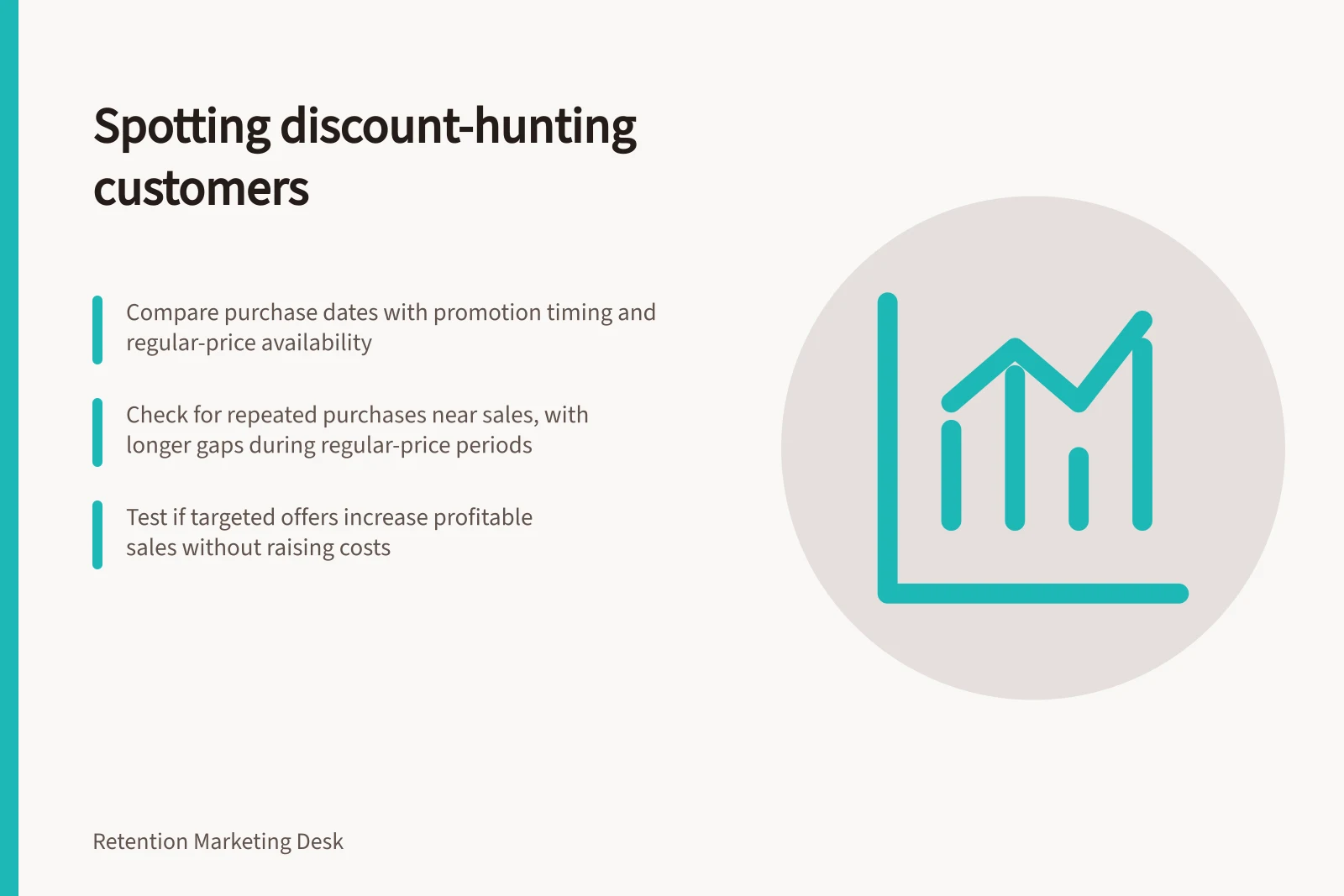
Repeated purchasing near promotions is a candidate signal, combined with longer gaps through comparable regular-price periods in which the customer previously bought. Inspect several cycles if they exist. Compare customers with similar products, prior purchase frequency and opportunities to receive an offer. One sale purchase, even a large one, is weak evidence.
Check other explanations. The promoted product may have returned to stock, a delivery problem may have interrupted earlier orders, or the sale may have coincided with a usual replenishment date. For goods customers can store, a larger sale basket may postpone the next order. Order histories do not reveal household inventory or intent.
Test whether another offer helps
The business question is whether an additional offer changes profitable purchasing. If contact permissions and sample size allow, define an eligible group before the next promotion and randomly assign some customers to receive a targeted offer while others receive no targeted offer.
Keep public prices, other contacts and observation time as comparable as possible. Compare completed purchases, regular-price orders and contribution per assigned customer through a plausible buying window. Include people who never redeem.
If the offer group buys during each promotion but contributes no more than the no-offer group overall, the discounts may be unnecessary. If withholding the offer reduces orders but the added sales still fail to cover the incentive, test a smaller or less frequent offer. A short observation period cannot reliably distinguish an additional purchase from one brought forward.
Avoid labelling individual customers as ‘trained’ in a profile or customer-facing message. Use the pattern to revise campaign rules and check whether the result holds across later promotions. Apply Australian consent, sender-identification and unsubscribe rules to any marketing email or SMS used in the test.
Steps to Test Discount Waiting Patterns
- Define eligible group before next promotion
- Randomly assign customers to offer or no-offer group
- Maintain comparable public prices and contact frequency
- Compare completed purchases and contribution over buying window
- Apply Australian consent and unsubscribe rules to all communications