Repeat Purchase
Part of Retention for low-frequency purchases
Choosing useful post-purchase value for durable products
Choose accurate setup, care, service and compatibility help that supports owners of durable products after purchase.
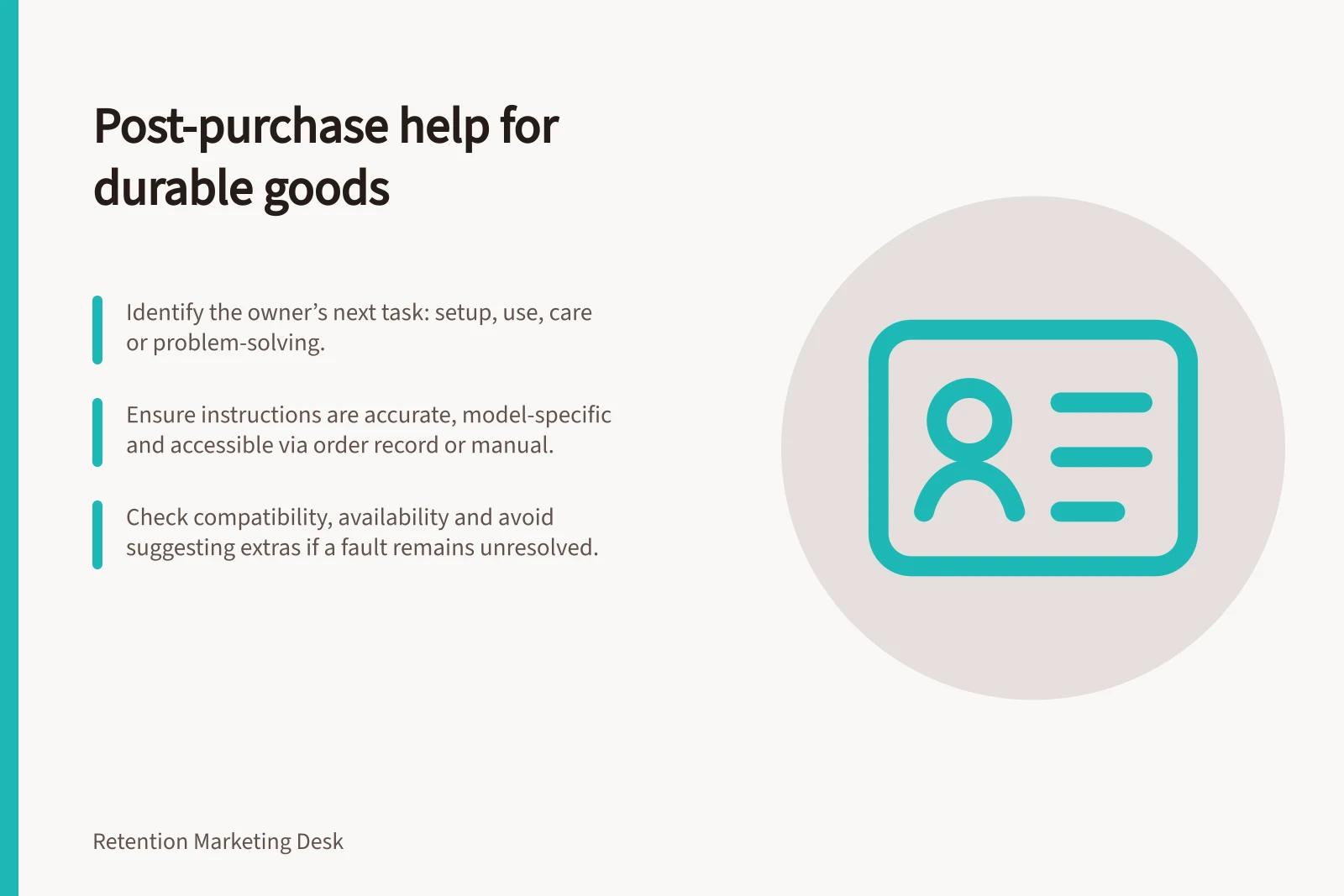
Choose post-purchase help by identifying the owner’s next task with the product. For a durable item, that may be setup, everyday use, care or resolving a problem. A sales suggestion is useful only when it answers a genuine, compatible need.
Start with the owner’s task
List the questions that arise after delivery. A furniture seller might need to explain assembly, surface care and how to request a replacement component. A specialist-equipment seller might need to explain safe setup and compatible accessories.
Check enquiries, return reasons and product documentation to decide which questions matter. A rarely asked safety or fault question may deserve attention even if a decorative tip gets more views.
| Moment | Customer question | Response to prepare |
|---|---|---|
| Delivery or setup | How do I start using this correctly? | Model-specific steps and a route to help |
| Ordinary use | How do I maintain it? | Verified care instructions and limitations |
| A problem | What can I do now? | A clear service contact and applicable remedy process |
| A related need | Will another item work with mine? | Checked compatibility, availability and total cost |
This map identifies help to investigate. It does not justify sending every item to every buyer.
Post-purchase support tasks for durable products
- Delivery or setupHow do I start using this correctly?
- Ordinary useHow do I maintain it?
- A problemWhat can I do now?
- A related needWill another item work with mine?
Make help accurate and easy to reach
Check instructions with the product owner or supplier before publishing. Name a model or material when it changes the advice. Confirm any advertised part or repair route is available under the stated conditions. Review the material when products change.
Keep the support path visible from the order record, manual or help page. A person with a fault should be able to report it without first reading a promotion.
In Australia, the ACCC educates consumers and businesses about their rights and responsibilities under consumer law. It can investigate reports that a business misleads consumers about their consumer guarantee rights. It does not provide legal advice or resolve individual disputes about whether the consumer guarantees have been met or the remedy.
Explain what a paid plan adds rather than implying that help depends on buying it.
Timing should follow the task. Setup help may suit delivery; later maintenance information should reflect the product’s actual needs. An order date alone cannot show how heavily an item has been used or whether replacement is due. When timing is uncertain, make help available on demand and let customers choose reminders.
Ensure post-purchase help is accurate and accessible
- Verify instructions with product owner or supplier
- Name model or material when advice changes
- Confirm advertised parts or repair routes are available
- Keep support path visible from order record, manual or help page
- Avoid requiring users to read promotions before reporting faults
Decide when a commercial suggestion belongs
A related product should solve a plausible use problem. Check fit with the purchased model, availability and whether the customer has already bought it. Give enough information to make the choice without implying that the original product is incomplete when it is not.
If the item is faulty, address the service issue first. An accessory discount does not substitute for a remedy that may be owed. For Australian promotional email or SMS, refer to the ACMA's guidance on avoiding spam before sending.
When to offer a commercial suggestion
- Plausible use problem
- Yes – only if the accessory solves a real need
- Compatibility with purchased model
- Must be verified
- Customer already owns it
- Do not suggest again
- Faulty item
- Fix service issue first – no discount substitutes remedy
Review whether the help worked
Use a measure tied to the task. For setup guidance, review questions that remain unanswered. For service instructions, check whether people reach the right team and whether the agreed action is completed. For an accessory suggestion, assess completed compatible orders and contribution after relevant costs.
A page view or click shows recorded access under the tool’s measurement rules. It does not show that a problem was solved or that a later sale was caused by the material. Read customer questions alongside the numbers and revise instructions that leave people stuck. A useful guide may still be worth keeping when its direct sales effect cannot be measured.
Measuring post-purchase help effectiveness
- Setup guidance success
- Unanswered questions after access
- Service instruction success
- Reached correct team; action completed
- Accessory suggestion performance
- Compatible orders completed; net contribution after costs
- Limitation of metrics
- Page views or clicks ≠ solved problems or sales impact