Cohort Analysis
Retention for low-frequency purchases
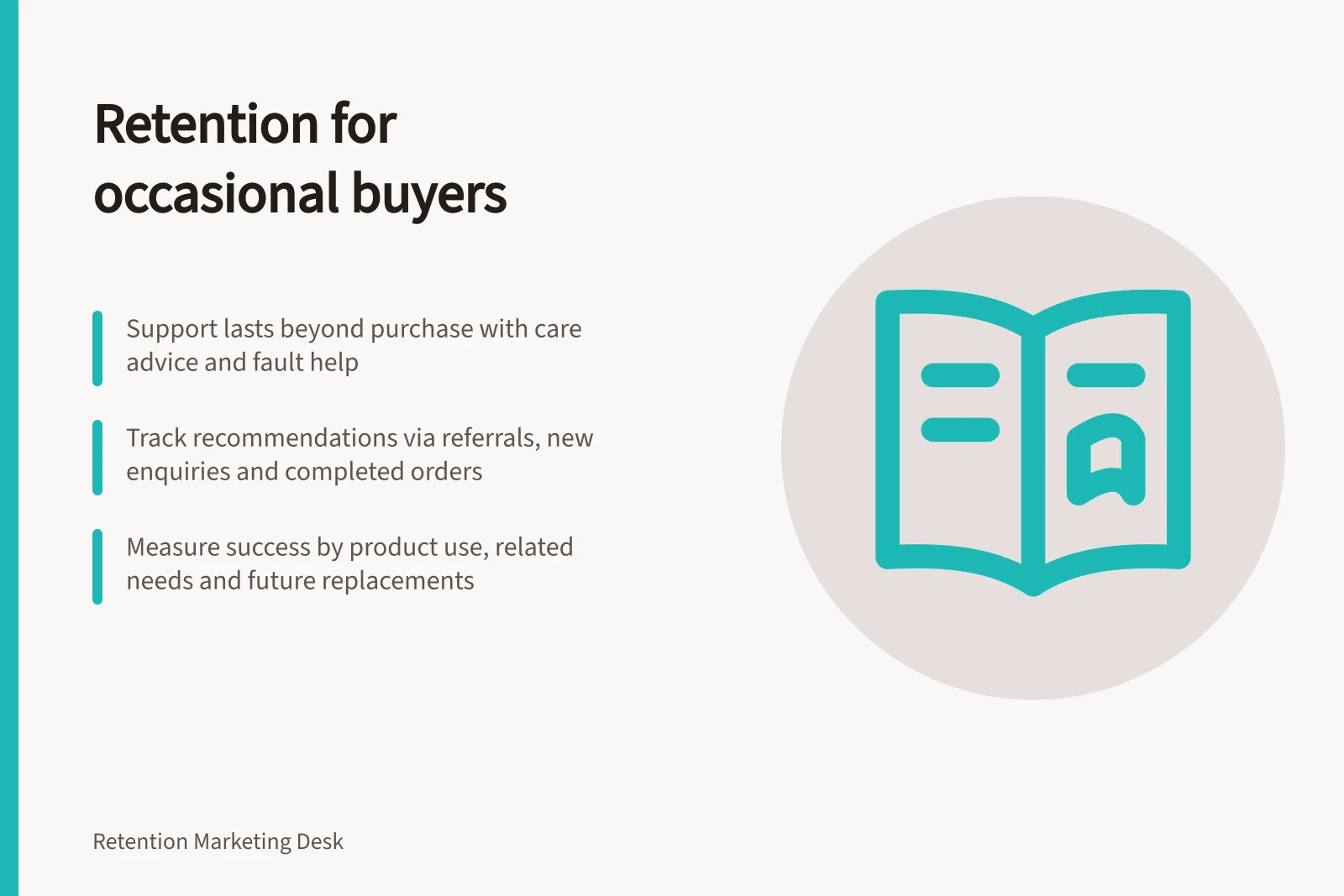
Plan useful post-purchase support, recommendations and relevant future sales for products customers buy only occasionally.
For a product bought only occasionally, retention means remaining useful and trustworthy until another relevant need arises. A customer who has not replaced a durable item may be getting exactly the use they expected from it.
Set goals around product support, recommendations and identifiable future opportunities rather than treating every quiet month as a missed repeat sale.
Map the next possible relationship
Start with the product and the buyer’s likely next decision. A dining table may need care advice or help with a fault long before its owner considers another table. A specialist tool might create a later need for a compatible accessory, a repair or equipment for a different task. A gift buyer may recommend the seller without needing the product personally.
| Path | Question to answer | Suitable evidence |
|---|---|---|
| Continued use | Can the customer get lasting value from the purchase? | Relevant help requests, resolved issues and voluntary feedback |
| Related need | Is there a compatible product or service the customer may need? | Product fit, enquiries and completed orders |
| Recommendation | Did a new buyer report or use a measurable recommendation route? | Buyer-reported introductions and tracked visits, kept separate |
| Eventual replacement | Has a new buying occasion arisen? | A customer request or later qualifying purchase |
These paths need separate measures. A care-guide visit shows information use, not a forecast order. An accessory sale is a related purchase, not necessarily replacement of the original item. A recommendation may create value even when the first customer never buys again.
Measuring Customer Engagement Across Different Retention Paths
- Continued Use
- Help requests, resolved issues, voluntary feedback
- Related Need
- Product fit, enquiries, completed accessory orders
- Recommendation
- Buyer-reported introductions, tracked visits via referral links
- Eventual Replacement
- Customer request or qualifying purchase for new item
Help at the point of use
Choose post-purchase help from questions owners face: setup, safe use, cleaning, compatibility, maintenance and where to seek assistance. Check advice against the specific product and current supplier information. Make information about support and consumer rights easy to find.
Time contact around a useful event, such as delivery, installation or a customer-requested service interval. An order date alone does not show that an item has worn out. Review content when models, parts or instructions change.
Check compatibility, availability and total cost before suggesting an accessory. Address an unresolved fault before promoting another purchase.
Be precise about the ACCC’s role when customers ask about consumer guarantees. The ACCC accepts reports and uses them to inform education, compliance and enforcement work, but it does not give case-specific legal advice or resolve individual disputes about a remedy. It may investigate if a business misleads consumers about their guarantee rights.
Post-Purchase Support Sequence for Durable Goods
- Delivery or InstallationTrigger support content and contact timing
- Setup & Safe Use GuidanceProvide clear instructions specific to product model
- Maintenance & Compatibility CheckReview part availability and total cost before suggesting add-ons
- Fault Resolution Before PromotionAddress unresolved issues before recommending further purchases
- Consumer Rights ClarificationExplain ACCC’s role: education, enforcement—not case-specific advice
Measure recommendations honestly
Give customers a straightforward way to pass on accurate product information. Track sharing, new enquiries naming a recommendation and completed orders from introduced buyers as different stages.
Keep buyer-reported and unknown sources visible. No single attribution method captures every private conversation or proves that a resulting sale was caused by a recommendation.
If the question is whether a referral prompt adds introductions, compare eligible customers offered the prompt with customers receiving the usual experience over a suitable decision period. That comparison concerns the prompt and the tested group, not every recommendation about the business.
Use a scorecard that respects the buying cycle
Report support, recommendation and sales outcomes on separate lines. For each rate, show the eligible population, observation period and definition of a completed order. Include relevant returns and costs when assessing contribution. Keep recent purchasers whose next opportunity has not arisen marked as pending.
Guide views and email clicks show recorded interactions, subject to each tool’s measurement limits. They do not establish future revenue. A forecast needs stated assumptions about buying opportunities, likely orders, contribution and time horizon. Label it as a projection, separate from observed sales.
Plan a restrained programme
Give each activity a customer benefit, owner, delivery cost and review point. Keep product and remedy support available regardless of marketing permission. For Australian promotional email or SMS, consult current ACMA guidance and check applicable requirements before sending.
Start with service gaps the business can fix, then review a small number of useful contacts. Correct messages that arrive at the wrong time or create questions the team cannot answer. Judge commercial results when a relevant buying opportunity has occurred.
Pre-Send Checklist for Australian Promotional Messages
- Comply with ACMA Spam GuidelinesInclude physical address and unsubscribe option
- Ensure Message RelevanceSend only when aligned with customer’s buying cycle stage
- Verify Team Can RespondConfirm staff can answer questions from messages sent
- Track Attribution SeparatelyDistinguish buyer-reported referrals from unknown sources
- Respect Marketing PermissionsOnly contact customers who have opted in
In this guide
- Choosing useful post-purchase value for durable productsChoose accurate setup, care, service and compatibility help that supports owners of durable products after purchase.
- Measuring recommendations when repeat purchase is rareSeparate recommendation intent, sharing, referred enquiries and completed sales when existing customers rarely repurchase.
- Distinguishing customer engagement from future revenueSeparate post-purchase interactions, genuine buying opportunities, observed sales and conditional revenue forecasts.
- Planning retention activity without unrealistic repeat-sale targetsSet useful activity, capacity and review targets for durable-product customers without forcing short-term repeat sales.