Win-Back Campaigns
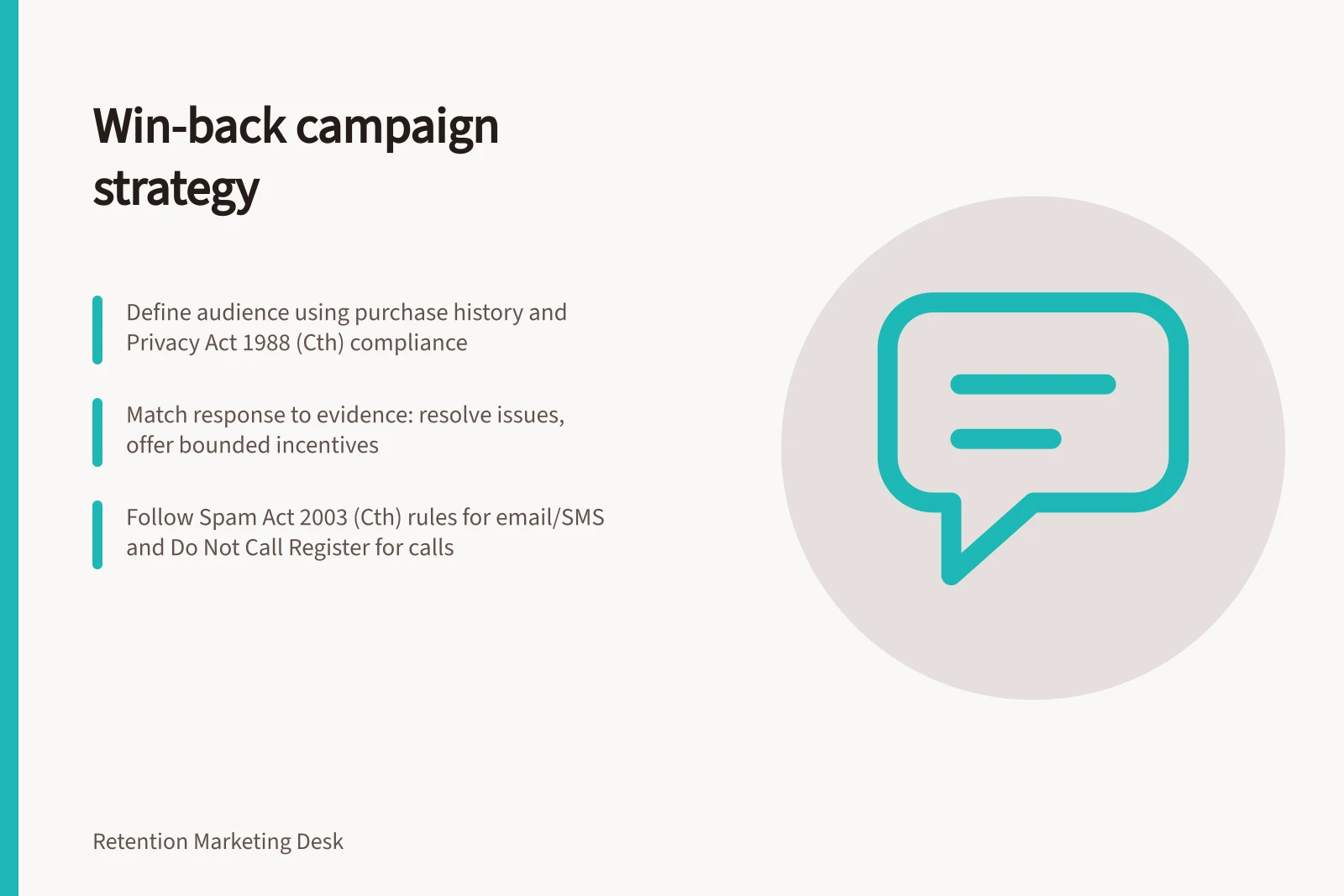
Win-back campaign strategy
Plan a win-back campaign around buying opportunities, relevant responses, Australian messaging requirements and profitable return behaviour.
A win-back campaign should contact customers whose absence is unusual given what they bought, give them a relevant reason to return, and check whether the activity adds profitable purchasing. Start with a plausible buying opportunity, not one store-wide number of days. A quiet customer may have bought a larger pack, be waiting for the next season or have an unresolved problem.
Define the campaign audience
Choose the purchase you hope to recover: another order in the same product group, a suitable substitute or any completed store order. Document how cancellations, returns, exchanges and subscription deliveries affect that rule. Check whether online and in-store orders can be joined before treating an apparent gap as inactivity.
Before joining online and in-store order records, review whether the planned use of purchase history and identity matching fits the Privacy Act 1988 (Cth) and your data practices. If identities cannot be matched reliably, keep those records in an unknown group rather than treating them as inactive.
Compare time since the last relevant purchase with a credible buying window for that product group. A repeat buyer’s own history can help; a first-time buyer needs a cautious comparison with similar buyers. Keep records with too little history or uncertain identity in an unknown group.
For a shampoo range, compare a repeat buyer’s last relevant order with the range’s typical interval; one way to estimate it is to average time between orders among customers with at least 2 purchases in the last 2 years. Use a separate, longer buying-cycle reference for couches rather than carrying over the shampoo rule.
An analytical candidate is not automatically contactable. Before each send, check for a new purchase, channel consent, an opt-out, a scheduled relevant subscription delivery and an unresolved service case. When a delayed message is about to send, run these checks again.
Buying cycles can differ substantially by product: a couch typically has a much longer cycle than shampoo. If customer-level predictive analytics are available for your segments, they can also help estimate when repeat customers are likely to buy again.
Match the action to the evidence
| What the records suggest | Response to consider | What remains unknown |
|---|---|---|
| Another relevant purchase may be useful | Make reordering or choosing a substitute easy | The customer’s current need or stock |
| A product or delivery problem remains open | Resolve the case and confirm the remedy | Whether it caused the inactivity |
| The customer has stated a credible price concern | Consider a bounded incentive after checking cost | Whether an incentive would add an order |
| No reason is supported | Send a restrained update, if contact is permitted | Why the customer stopped ordering |
It can reduce contribution on a purchase that would have happened anyway. Set eligible products, maximum benefit, expiry and stacking rules before launch. Avoid savings claims that the offer terms do not support, and state exclusions plainly.
Keep evidence for factual claims in campaign copy. The Australian Competition and Consumer Commission can require businesses to back up claims about products or services, and may investigate claims it considers misleading.
Plan the contact and comparison
Give each message a purpose. An initial contact might offer a relevant reorder route or describe a real improvement.
For email and SMS, commercial messages are governed by the Spam Act 2003 (Cth): have express or inferred consent, identify the sender and include a functional unsubscribe. The unsubscribe must work for at least 30 days and be actioned within 5 business days; ACMA can fine businesses for non-compliance.
For telemarketing, check the Do Not Call Register before contact; it does not cover marketing texts, which are governed by the Spam Act. Since 1 July 2026, businesses sending branded text messages must register their sender ID with the SMS Sender ID Register.
A follow-up should address a different practical barrier, if there is one. Stop after a relevant repurchase, opt-out or service escalation. Do not claim to know why someone left or that they are due for a refill when the records cannot show it.
Plan a simple campaign-level comparison before sending: record the eligible population, the action and the review date, then check whether the activity is associated with profitable purchasing.
Where practical, reserve a holdout group of eligible customers that receives no win-back messages, then compare its purchases with those of the contacted group. This gives the campaign a named comparison design for estimating incremental success.
Use a suitable comparison where practical so observed purchases are not presented as campaign-caused recovery.
Decide what to do next
Record the audience rule, exclusions, supported barrier, action, offer limit, contact permission, comparison plan and review date. Inspect customer histories near the eligibility boundary before activation. After the review period, keep, narrow, change or stop the action according to return behaviour and contribution. Preserve the rule and results for the next review.
In this guide
- Identifying lapsed customers by normal purchase cadenceSet a product-specific win-back boundary from purchase gaps, audit cases near it and separate candidates from customers eligible for contact.
- Choosing a win-back offer from the reason for inactivityUse order, service and customer evidence to choose a win-back response, resolve owed remedies and check discretionary incentives.
- Measuring recovered customers beyond the first discounted orderDefine first return, later repeat purchase and contribution per assigned customer to assess recovery after a win-back discount.