Churn Diagnosis
Part of Churn research
Testing a reported churn reason against lost-customer purchase histories
Build a customer timeline and distinguish records that support, complicate or cannot test a stated churn reason.
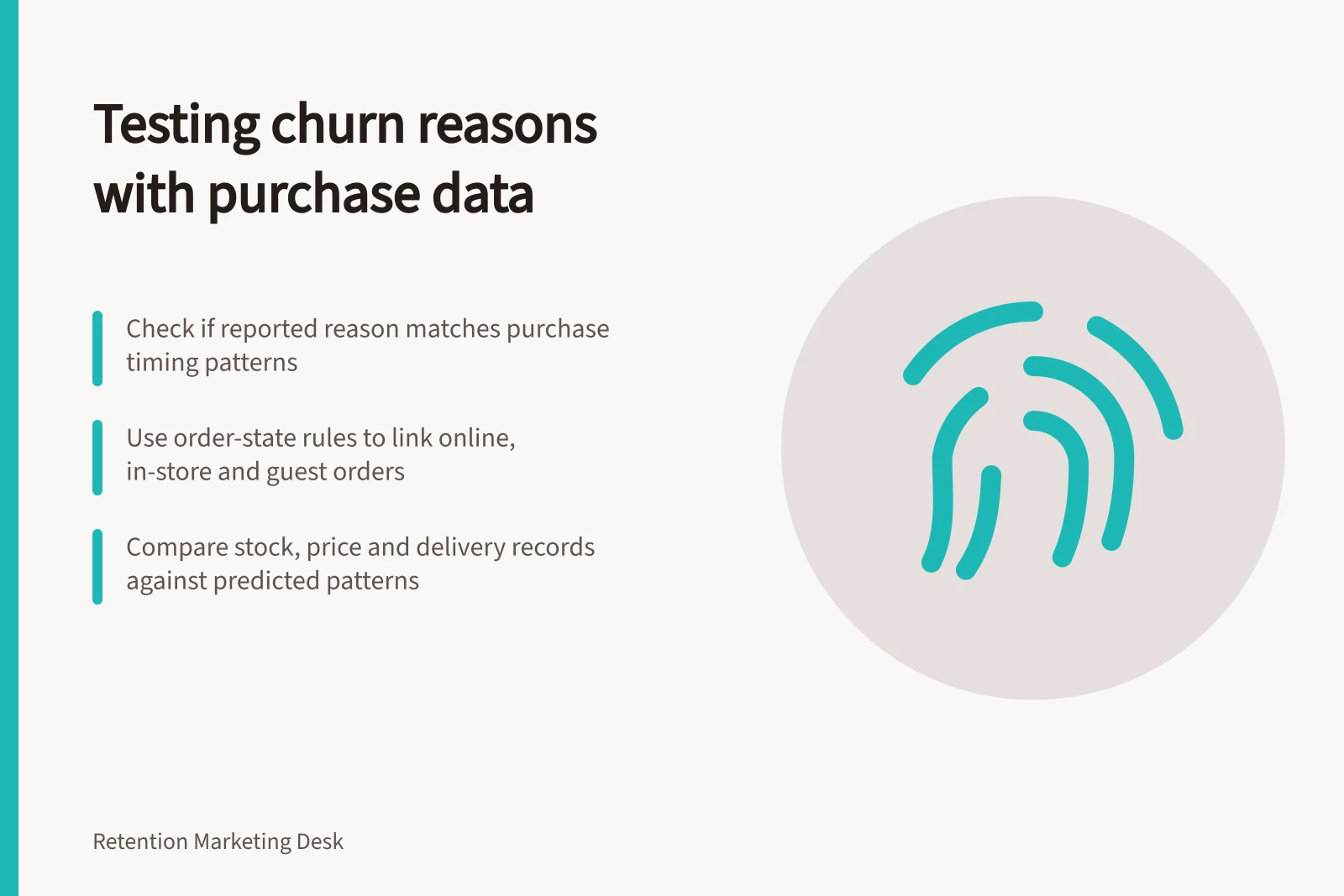
A customer’s reported reason for stopping can be checked against purchase timing. Build a timeline from the last relevant order through the next plausible buying opportunity. Ask what pattern the reason predicts and whether records support, complicate or conflict with it. A match strengthens a hypothesis; it does not prove what caused the gap.
Set the comparison window
Record the customer’s statement before searching for supporting transactions. Define the relevant product and substitutes, last completed purchase, date of the reported issue and reporting cut-off. Allow for the product’s buying cycle. Someone who bought a large supply shortly before a complaint may have had no immediate reason to reorder.
Use one order-state rule for cancellations, full and partial refunds, replacements and subscription deliveries. Check whether guest, account, online and in-store orders are linked. A missing channel can create a false end to the history.
Specify what the reason predicts
| Reported reason | Pattern to check | Alternative to keep open |
|---|---|---|
| “The item was never available when I needed it” | Stock records around the next plausible purchase date | Changed need or a purchase elsewhere that these records cannot show |
| “The last delivery put me off” | Delivery and service timeline before the gap | A larger final order or seasonal pause |
| “I stopped because the price rose” | Comparable pack, paid price and offer history | Quantity, product or service changes that altered the trade-off |
| “I no longer needed it” | Later orders serving the same need in this business’s records | An order through a missing channel |
The table’s entries are hypothetical examples, not sourced quotations or survey responses.
These are proposed checks, not results. A retailer’s order history cannot establish that a customer bought from a competitor. A service case marked closed does not establish that the customer considered it resolved. Stock, offer and case records may be needed alongside purchases to test parts of an account.
Churn Reason Predictions vs. Purchase History Evidence
- Reported reason: Item never available when needed
- Check stock records around next plausible purchase date
- Reported reason: Last delivery put me off
- Review delivery and service timeline before gap
- Reported reason: Price rose
- Compare pack size, paid price, and offer history
- Reported reason: No longer needed
- Look for later orders serving same need in records
Compare and classify cases
Review several customers who reported the same reason, if available. Other interviewed customers can help reveal whether the proposed pattern is specific to that reason. Keep people who gave no reason in an unknown group. Compare product, purchase period and opportunity to return as closely as practical. Interviewees remain a selected subset of inactive customers.
For each case, note whether records broadly align, raise a material conflict, cannot test the claim or call for clarification. Record mixed evidence rather than forcing a clean verdict. A later purchase does not erase an earlier problem; one promotional purchase before inactivity does not confirm a price-driven exit.
State what the check changed
Keep the statement, event dates, purchases reviewed, missing channels, expected and observed patterns, and competing explanations together. At group level, give the number of cases reviewed. State the sample’s limits.
A bounded conclusion might be: “The availability explanation fits several interviewed customers’ timelines, but stock records are incomplete and most inactive customers were not interviewed.” The next step is to resolve the missing evidence or examine availability for the relevant product. Whether a later fix changes purchasing requires separate measurement after another buying opportunity.