Churn Diagnosis
Part of Churn research
Grouping churn reasons into actionable categories
Build a clear churn-reason codebook, retain multiple reasons and unknowns, and connect each category to a practical check.
Group reported churn reasons by the question a team can investigate. Keep the customer’s words and uncertainty visible. A category is a working label for an account, not proof of motive, and one account may support several labels.
Build the codebook from accounts
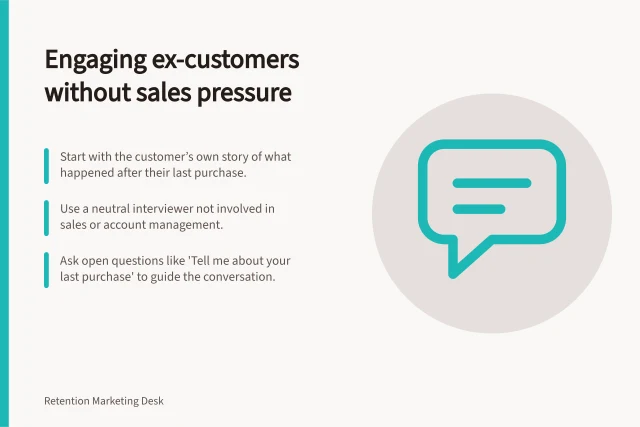
Read a varied set of interview notes or open-text responses before fixing the categories. Identify what people describe: an unavailable item, a delivery problem, a product that no longer suits them, or an alternative they prefer. Separate the account from the researcher’s interpretation.
For each code, record its name, what qualifies, what does not, and a brief example. Allow secondary codes. Use “unknown or unclear” when an answer does not support a reason. Use “no further need” only when a customer clearly says the original need ended; silence supports neither category.
| Working category | Apply when the account describes | First check |
|---|---|---|
| Availability | The wanted item or a suitable substitute could not be bought when needed | Stock history for the relevant dates |
| Experience | Delivery, product or support fell short of a stated expectation | Order and case timeline |
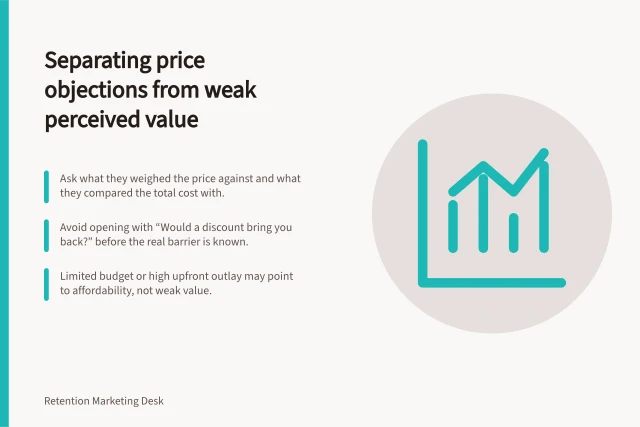
| Economic fit | The outlay or trade-off no longer worked for the customer | Price, quantity and alternatives compared |
| Changed need | The original use or occasion ended or changed | Whether another purchase was plausibly due |
| Unknown | The account is missing, vague or contradictory | Whether follow-up or records can clarify it |
These are example categories, not findings about a business. A customer who says a product arrived late and cost too much for its quality may receive both experience and economic-fit codes.
Building a Reliable Churn Codebook
- Review diverse accounts firstRead interview notes or open-text responses before finalising categories
- Define each code clearlySpecify what qualifies, what does not, and include a brief example
- Allow secondary codesA customer may belong to more than one category (e.g., Experience + Economic fit)
- Use 'unknown or unclear' wiselyOnly apply when the answer lacks clarity; silence is not evidence of 'no further need'
- Document changesRecord when codebook updates occur to ensure consistent comparisons
Report counts carefully
Count customers, not mentions, when stating how many interviewees raised a theme. With multiple codes, category totals can exceed the number interviewed; say so. Keep eligible, invited and response counts beside the coded sample. A self-selected interview group does not yield a percentage for all inactive customers.
Ask a second reader to code difficult accounts using the written definitions. Discuss differences, clarify the boundary, and revisit earlier cases. Preserve the original answer when a code changes. If a new pattern requires a code, record when the codebook changed, so later comparisons do not silently mix definitions.
Key Principles for Reporting Churn Code Counts
- Count customers, not mentions
- Category totals may exceed interviewee count when multiple codes apply
- Include response rates
- Report eligible, invited and response counts alongside coded sample
- No percentage claims
- Self-selected interviews do not represent all inactive customers
- Use second reader validation
- Discuss discrepancies and clarify code boundaries
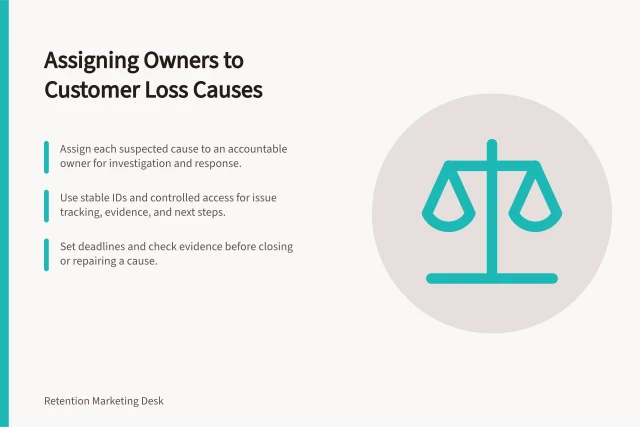
Give each category a next question
“Delivery” alone is broad. Ask whether dispatch, the stated estimate, or the carrier handoff failed. “Price” needs a check of what the customer compared before anyone proposes a discount. An unknown category is useful when it prevents an unsupported action.
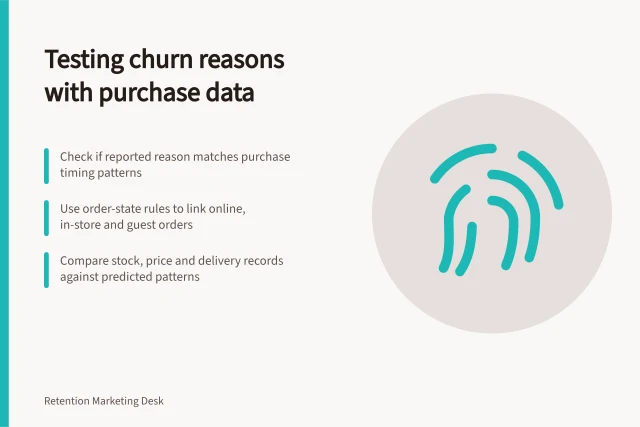
Report a theme with its source and limit: “Among interviewed former buyers of this product, some described an availability problem near their expected reorder period.” Then name the record check that could strengthen or weaken that interpretation. The codebook organises what people said; it does not prove why the wider customer base stopped buying.
Churn Reason Categories and Their Investigative Next Steps
- Availability
- Check stock history for the relevant dates
- Experience
- Review order and case timeline for delivery, product or support failures
- Economic fit
- Compare price, quantity and alternatives to assess affordability
- Changed need
- Assess whether another purchase was plausibly due based on usage patterns
- Unknown
- Determine if follow-up or records can clarify the account