Churn Diagnosis
Part of Churn research
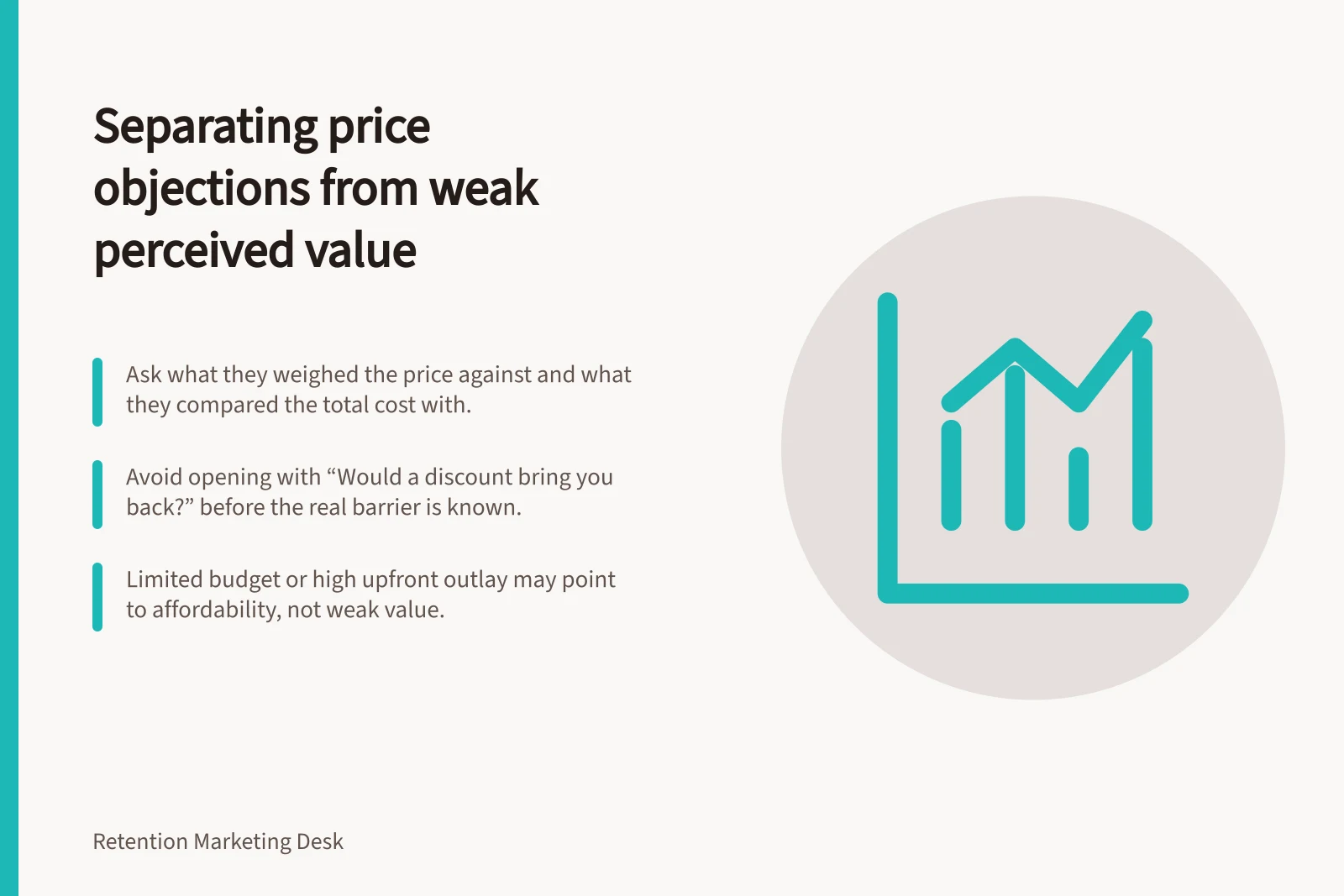
Separating price objections from weak perceived value
Use neutral questions and purchase context to distinguish an outlay barrier from a product or service value problem.
When a former customer says “too expensive”, ask what they weighed the price against. They may have wanted the product but could not manage the outlay then, or could have paid but found quality, benefits or service disappointing. Both may apply. The phrase alone does not identify the right response.
Ask about the choice
Start with the customer's last considered purchase. Ask what they needed, what options were available and why the chosen option suited them. If price comes up, use neutral follow-ups:
- “What were you comparing the total cost with?”
- “Which part of the offer did not feel worth that amount?”
- “What, if anything, would have changed your choice?”
- “Was the product or service different from what you expected?”
An answer about a hypothetical different price is a clue, not a prediction of a later purchase. Avoid opening with “Would a discount bring you back?” It proposes a remedy before the barrier is understood.
Neutral follow-ups when price comes up
- What were you comparing the total cost with?
- Which part of the offer did not feel worth that amount?
- What, if anything, would have changed your choice?
- Was the product or service different from what you expected?
Interpret the account in context
A limited budget or high upfront outlay may point to affordability even when the person liked the product. A complaint about performance, pack size, durability or delivery may point to weak perceived value. A cheaper substitute may have changed both the cost comparison and expected benefit.
| Account to investigate | Follow-up | Possible next check |
|---|---|---|
| “I still wanted it, but could not spend that much then” | Was timing or total outlay the barrier? | Whether an available smaller pack or bounded offer would suit the need |
| “It was not worth what I paid” | Which expected benefit was missing? | Product, promise or service records |
| “Another option suited me better” | Which features and costs mattered together? | Fit of the current offer for that use |
| “I no longer needed it” | Had the original need ended? | Whether another purchase was plausibly due |
These are possible interpretations, not automatic classifications. Route a product fault or unresolved service issue to the appropriate team before treating the account as a discount opportunity.
Outlay barrier or weak perceived value?
- Outlay barrier (affordability)Limited budget, high upfront outlay or timing — the customer still wanted the product but could not manage the spend then
- Weak perceived valueComplaints about performance, pack size, durability or delivery — the offer fell short of what was expected
Check behaviour without assigning motive
Review relevant orders: regular and promotional prices paid, quantity, returns, product changes and buying opportunities.
A past regular-price purchase shows what the customer paid then, not what they could afford later. A discounted purchase shows a transaction under those terms, not that the discount caused it or would restore future purchasing.
Compare the account with the offer available at the decision date. Was the usual item in stock? Was the pack and delivery basis comparable?
Had an earlier large order delayed the next need? Record data gaps instead of declaring the objection disproved.
Finish with a bounded hypothesis and a next check. An apparent outlay barrier may justify examining pack options. Weak perceived value may justify a product or expectation review. Any incentive is a later commercial decision whose effect an interview cannot establish.