Repeat Purchase
Part of Replenishment retention
Estimating a likely replenishment interval
Use comparable repeat purchases to estimate a reorder window, while accounting for pack size, sparse histories and buyers who have not reordered.
Estimate a replenishment interval from comparable repeat purchases. Treat it as a window to test, not a prediction of the day someone will run out. Orders record buying, not consumption, but they can be a starting point if products, quantities and the time customers have had to reorder are handled consistently.
Define a relevant repeat purchase
Choose a product or group of genuine substitutes. An identical-SKU rule may miss a real replenishment when a customer switches between pack sizes or scents of the same consumable. Do not combine products with very different amounts of usable supply simply because they share a category.
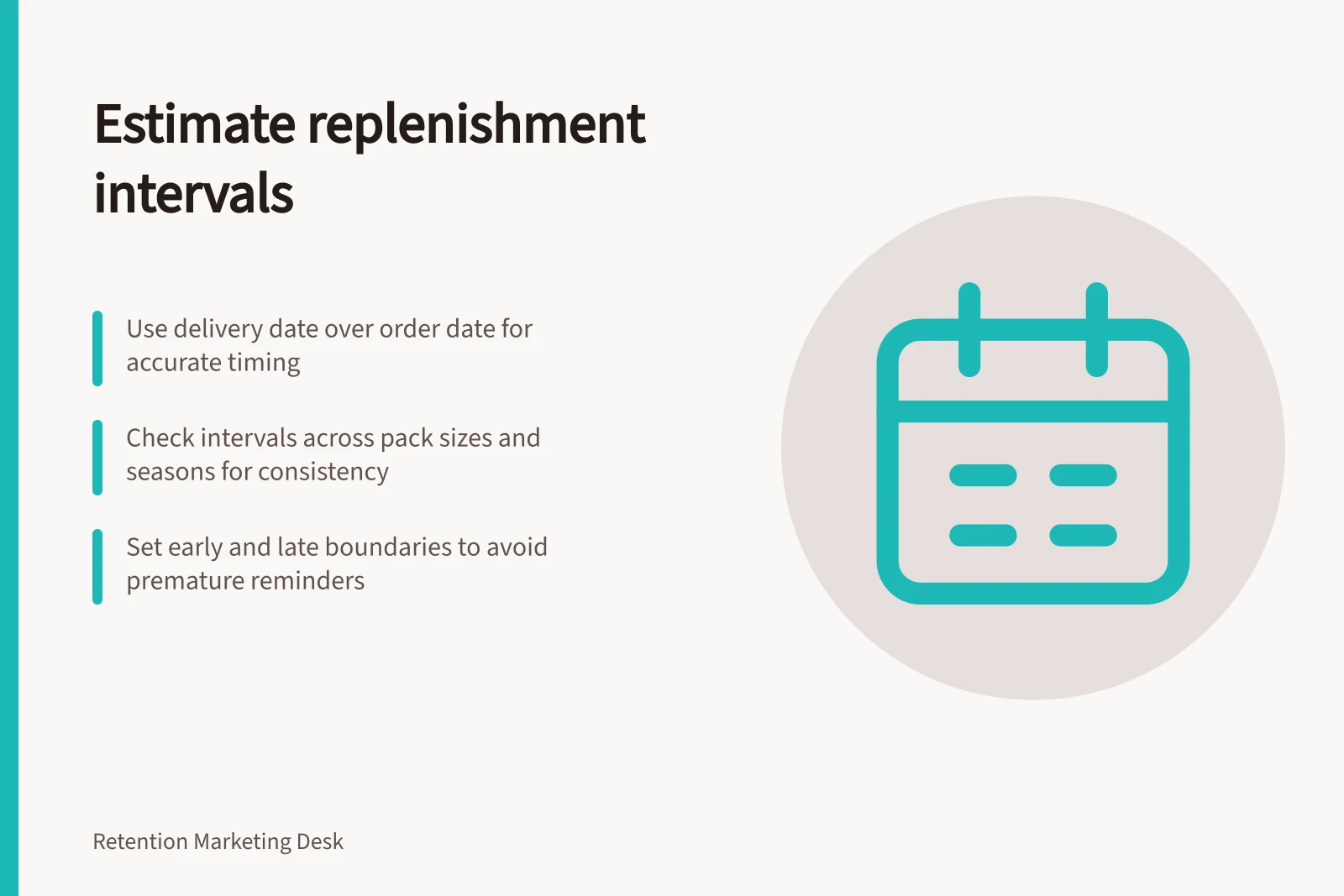
Use completed, non-returned purchases and a consistent date rule. Order date is easy to obtain, but a long dispatch delay may make delivery date more relevant. Neither date proves when use began. Record the date you use, and keep one-time purchases separate from subscription deliveries.
Order Date vs Delivery Date for Replenishment Timing
- Order Date
- Easier to obtain, but may not reflect actual consumption start.
- Delivery Date
- More accurate for timing use, especially if dispatch delays are common.
Examine the intervals and the missing observations
For customers with at least two relevant purchases, calculate the elapsed time between successive purchases. Inspect the middle of the distribution, plus shorter and longer gaps; an average alone can conceal a wide spread. Check whether intervals differ by pack size, quantity or season before applying one rule to all buyers.
Repeat buyers are a selected group. Customers with one order have no observed repeat interval, and recent buyers have had less time to return. Keep them visible in the broader cohort; do not label them late because they are absent from an interval table. If histories are sparse, combine only comparable products, or use a cautious product-use assumption and test it.
A customer's own history may refine the estimate after several comparable purchases. For a first-time buyer, use a product-group window provisionally. Reconsider it after a return, pack-size change or multi-unit order.
Turn the estimate into a reminder rule
Set an early and late boundary around the likely buying window. Leave enough time for the customer to order and receive the item, without claiming to know their stock level. If the spread is wide, asking for a preferred reminder date may be more useful than a precise automated countdown.
Before sending, check for another relevant order. Review sample histories near the proposed cutoff for bulk purchases, gifts and delayed deliveries. Record which data and rule produced the reminder date, then compare it with another plausible timing in a fair test. An interval estimate alone does not show that sending a reminder helps.
Key Metrics for Replenishment Interval Estimation
- Minimum interval
- Shortest observed gap between repeat purchases
- Median interval
- Middle value of all repeat purchase intervals
- Maximum interval
- Longest observed gap between repeat purchases
- Cutoff window (early)
- Set before median to allow for early reorder
- Cutoff window (late)
- Set after median to avoid missing late reorderers