Repeat Purchase
Part of Replenishment retention
Measuring whether replenishment reminders improve profitable repeat purchase
Use a no-reminder control and complete order contribution to see whether replenishment messages add profitable repeat purchases.
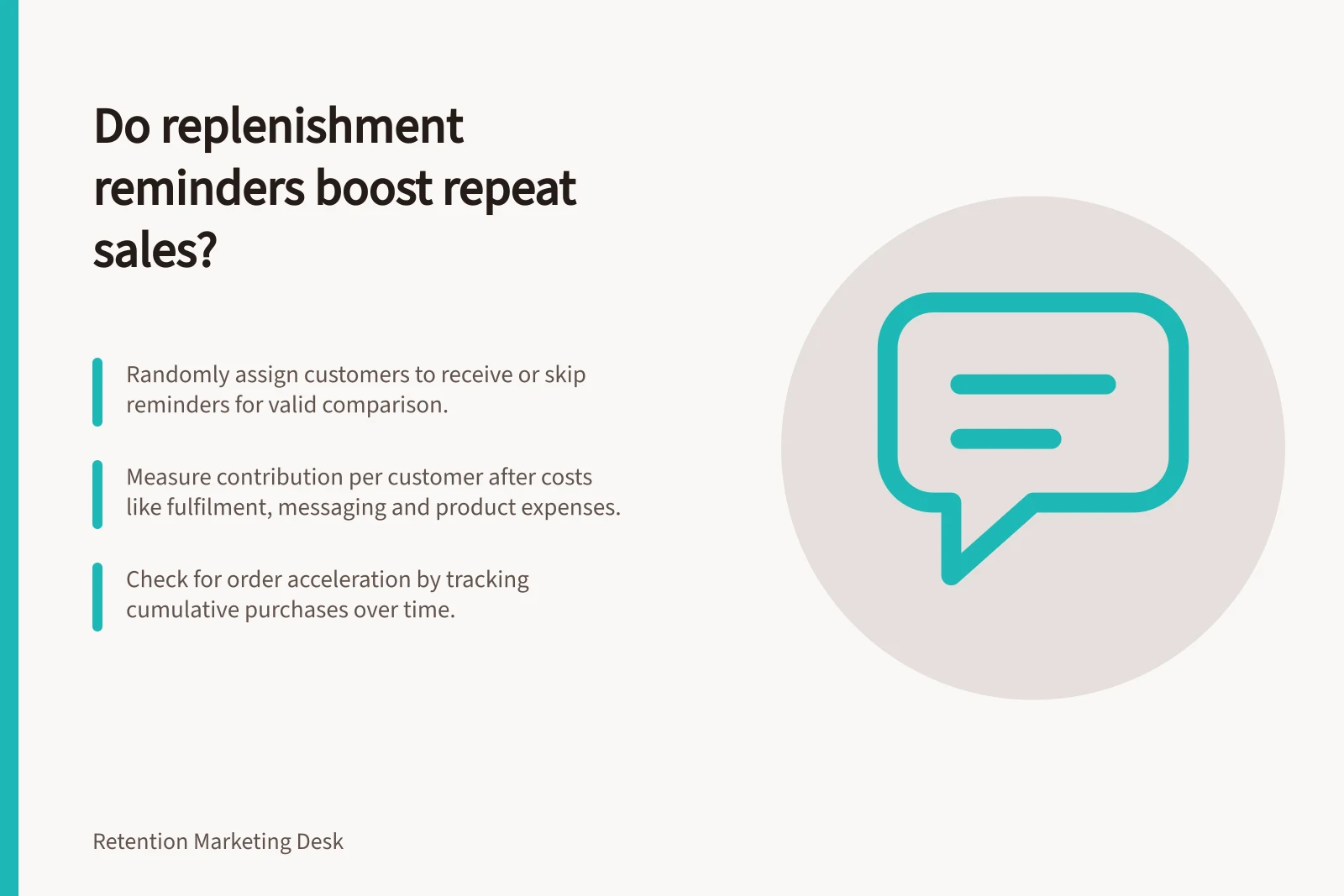
Randomly assign eligible customers either to receive the replenishment reminder program or to no replenishment reminder, to test whether reminders add profitable repeat purchases. Compare purchases and contribution per assigned customer over the same follow-up period. Orders attributed to an email do not, by themselves, establish that it caused extra orders.
Define the test and its outcome
Specify qualifying customers and products, when eligibility begins, the reminder's content and the end of follow-up. Assign at customer level so one person cannot enter both groups through different orders. Apply identical eligibility and suppression rules to both groups, and record other marketing that may reach them.
Decide whether the main commercial outcome is contribution from relevant repeat orders or from all orders during follow-up. The broader measure can detect a reminder that changes other purchases; report relevant-product orders separately.
A no-reminder control addresses whether the program adds value. Comparing two reminder versions answers which version performs better, not whether either beats no reminder.
A platform-wide holdout can suppress unrelated marketing and change the question. Klaviyo's global holdout spans campaigns and flows across channels and requires at least 400,000 profiles. Confirm the scope of any control mechanism before using it for a replenishment-only comparison.
Calculate contribution per assigned customer
Count relevant repeat purchasers and completed repeat orders in both groups over the agreed period, including orders without a reminder click. Keep every assigned customer in the denominator, including those whose reminder was later suppressed under the common rules.
For the chosen commercial outcome, start with net sales after discounts and returns. Subtract product cost and relevant variable costs, such as fulfilment, payment, messaging and the offer. Include message costs for recipients who never buy.
Sum contribution within each group and divide by the number of customers assigned to that group, then compare the two figures. The difference estimates incremental contribution for the tested population and period, subject to sampling uncertainty and data quality.
A gross-profit report may help with product cost, but check whether it covers the costs needed here. If costs are missing, label the result a partial contribution measure rather than a profit uplift.
Check whether purchases merely moved earlier
Plot cumulative repeat purchases through the full follow-up period. A reminder may shift an order into an earlier week without changing eventual repeat purchasing. Review order size, discounts, returns, opt-outs and complaints alongside purchase counts. A short window can make acceleration look like an enduring increase.
Report group sizes, allocation, dates, exclusions, cost coverage and the observed difference. If the estimate is small or uncertain, say so. A result from one product group, season or consented audience should not be presented as a result for every customer.