Retention Operations
Retention segmentation
Build retention segments around purchase behaviour and a distinct next action, then check data quality and contact eligibility.
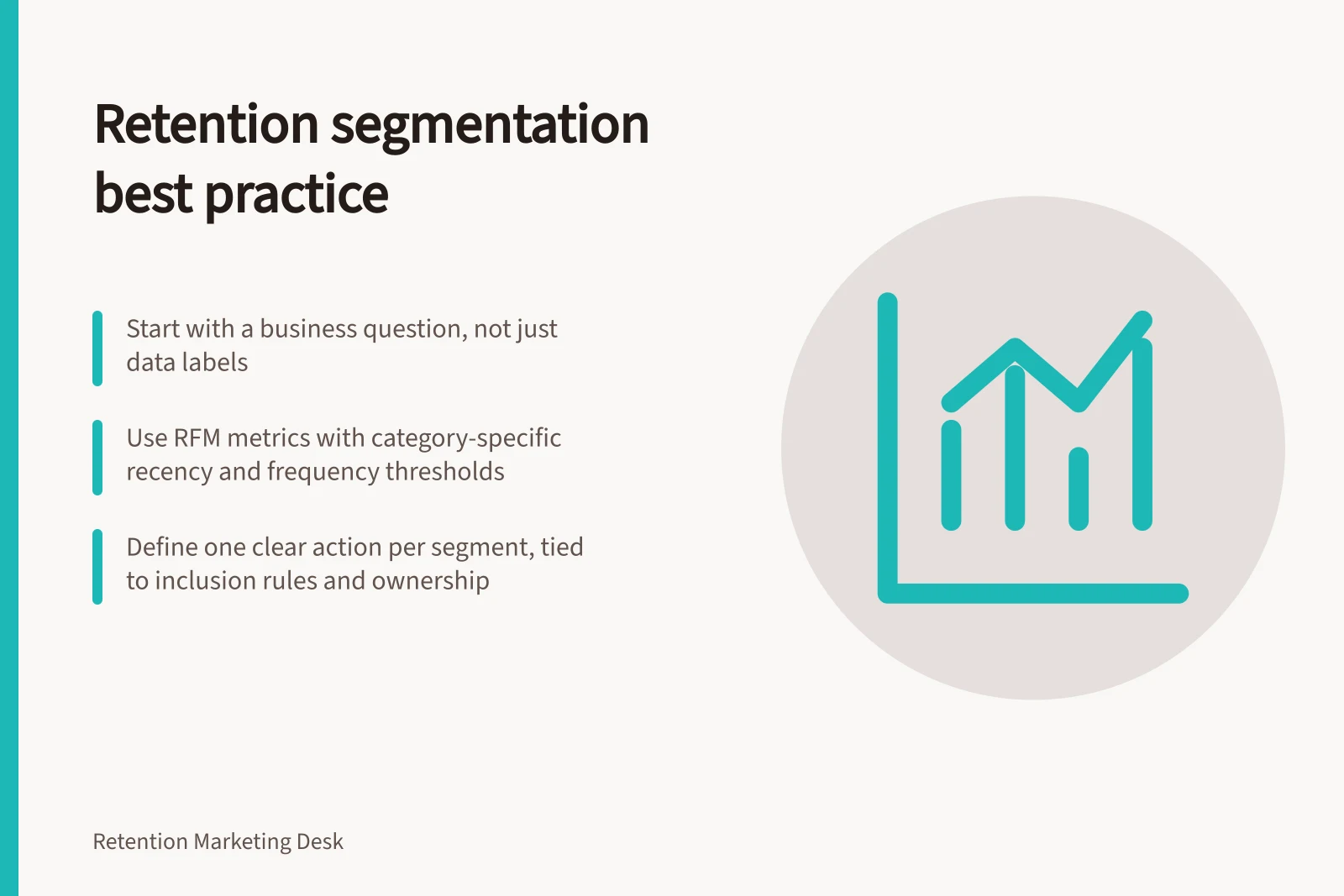
A retention segment is useful when it changes what the team does. Splitting customers into many labels without a distinct message, service response or measurement plan adds complexity, not relevance. Start with a business question, then choose data that can answer it.
Use behaviour the store can explain
Purchase recency, repeat frequency, product category and spend reveal different patterns. Shopify’s segment filters include first and last order date, number of orders, amount spent and products purchased.
Klaviyo documents RFM group properties for segments, noting Advanced KDP and Marketing Analytics are not included in its standard marketing application; a subscription is required to access the associated functionality. These are platform capabilities, not universal definitions of “loyal” or “at risk”.
Thresholds for recency and frequency depend on the category’s buying rhythm; see our article on segmenting customers by purchase rhythm for that detail. Check returns, cancellations and gift purchases before treating a record as repeat demand. Avoid presenting a predicted label as fact about why a person stopped buying.
Shopify vs. Klaviyo: Segmenting Capabilities for Retention
- Purchase Recency & FrequencyAvailable in both Shopify and Klaviyo; thresholds depend on category rhythm.
- RFM Group PropertiesKlaviyo offers RFM groups but requires Advanced KDP and Marketing Analytics subscription.
- Abandoned Checkout DateSupported in Shopify with date ranges and offsets (e.g., `-7d`).
- Customer Context FiltersShopify includes language, region, tags, email domain; use only when they drive different actions.
- Profile Refresh TimingKlaviyo RFM updates nightly; dashboard may show temporary discrepancies.
Give every segment one decision
For each group, write the inclusion rule, reason it matters, owner and next action. A high-value customer whose activity has slowed might receive a service check or relevant replenishment reminder; a one-off gift buyer may need a different offer. Make the action useful without assuming the buyer’s motive. Suppress people not eligible for the intended marketing channel and respect their preferences.
Choose filters that shape the response
A segment can also reflect customer context, not just transaction history. Shopify’s available filters include customer language, city, country or region, state or province, customer tags, customer account status and customer email domain. Use a field only when its value helps determine a different message, service response or measurement; otherwise it adds another label without clarifying the decision.
Shopify also provides filters for abandoned checkout date, anniversary, customer added date, email events, storefront events, store credit accounts and product subscription status. These let a segment rule describe a recorded event or account attribute. Before relying on it for a campaign or service workflow, check the field is populated and represents the intended group.
Where a customer may qualify through more than one dimension, combine the criteria in the segment rule. For example, combine a location or language criterion with a recorded event instead of treating all customers as one audience. Use the documented field and operator, not an informal label.
Make date rules reproducible
Date-based filters need an explicit boundary. Shopify’s abandoned checkout date filter supports exact dates, date ranges and offsets; for example, abandoned_checkout_date >= -7d includes customers whose last abandoned checkout was within the last week. State the event, comparison and time window so another operator can reproduce the audience.
Shopify date values use entire days and depend on the store’s time zone. The anniversary filter does not account for the year. For birth-date filtering, activate the facts.birth_date standard metafield or create a custom metafield. Confirm these field details before reading an empty or unexpectedly broad segment as a customer pattern.
Separate channel and account criteria
Shopify offers separate email subscription status and SMS subscription status filters, as well as customer account status. Keep those properties distinct when defining an audience: a segment intended for one channel should use the relevant channel field, not assume one status describes every contact route.
Check sample records against the relevant channel field before using the segment.
Check how platform properties refresh
Platform-generated properties can change on a schedule that affects who appears in a segment. Klaviyo says its RFM properties refresh every night, checking for profile updates every 24 hours, while the RFM dashboard updates immediately. The dashboard’s group counts may therefore differ temporarily from values on profile records.
Klaviyo’s current RFM group and previous RFM group are segment-usable properties; the profile also records the timestamp of the last group change. Previous RFM group remains Unknown until the profile’s group changes. If a segment relies on either group property, check the profile property rather than assuming the dashboard and profile update together.
Pre-Campaign Segment Validation Checklist
- Confirm field is populatedEnsure customer attributes like birth date or subscription status are recorded.
- Verify time zone alignmentDate-based segments depend on store’s time zone setting.
- Check refresh frequencyKlaviyo RFM updates daily; profile timestamps help track changes.
- Test sample recordsReview actual customer data before launching campaigns.
- Ensure channel-specific eligibilityUse correct subscription status (email/SMS) for intended contact method.
Review segment performance
Compare outcomes with a suitable reference group and watch complaints and opt-outs, not only revenue. For guidance on explaining segment entry, overlap, precedence and documentation, see our article on keeping retention segments interpretable for operators.
In this guide
- Identifying high-value customers with declining activityFind historically valuable customers whose recent pattern has changed, while checking service and category context before outreach.
- Distinguishing one-off gift buyers from repeat customersAvoid treating every one-time gift purchase as the beginning of a replenishment or repeat-buying cycle.
- Keeping retention segments interpretable for operatorsMake retention segments understandable enough for operators to explain, maintain and safely act on.