Churn Diagnosis
Part of Customer retention diagnosis
Separating customer loss from naturally infrequent buying
Assess a quiet customer history against product buying opportunities, comparable purchase gaps and complete observation windows.
A long gap without an order shows inactivity, not confirmed customer loss. When customers do not formally cancel, the end of a purchasing relationship is usually unobserved. Compare the gap with genuine opportunities to buy the product again, and keep the conclusion provisional.
Establish what a normal gap could be
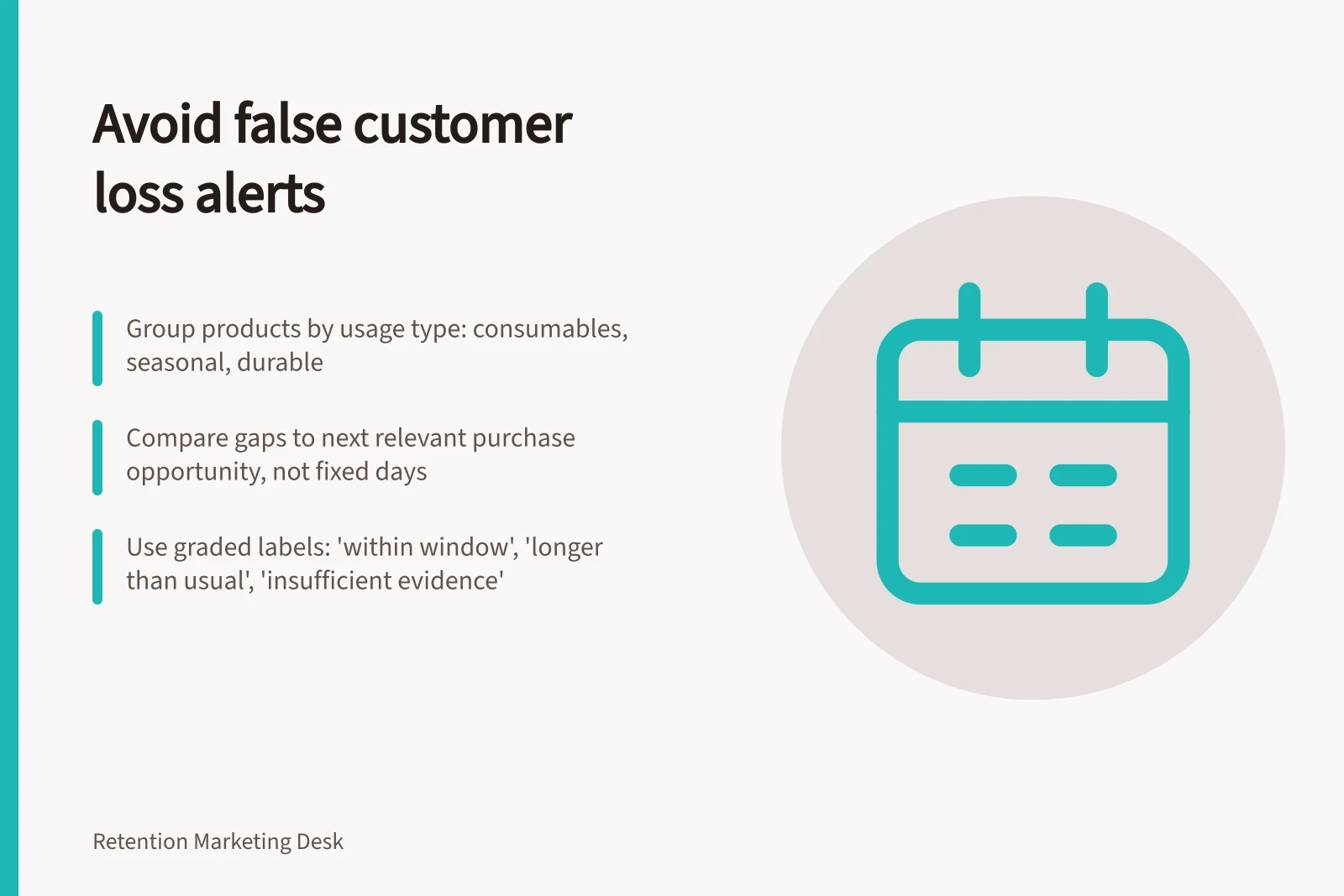
Group purchases that serve similar needs. A refill, a seasonal item and a durable product should not share one inactivity clock. Within each group, examine the time between relevant completed purchases among customers who bought again. Look at the spread rather than a single average: some return quickly and others much later.
That history is a starting point. It contains intervals only for people who repeated, so it cannot establish what every one-order customer will do. Pack size, quantity, delivery timing and product availability can also shift the next plausible purchase date. Review those details before setting a boundary for investigation.
For an item bought for an annual occasion, compare the customer with the next relevant occasion rather than an arbitrary number of days. For a durable item expected to last years, a quiet quarter offers little evidence of loss. These are category checks, not predictions that a particular customer will return.
Customer Inactivity vs. Naturally Infrequent Buying: Key Differences
- Product Type
- Consumable (e.g., toiletries, groceries)
- Product Type
- Durable (e.g., appliance, furniture)
Give every customer enough observation time
A recent buyer has had less chance to repeat than someone whose first order was much earlier. In a repeat check with a defined observation window, a buyer observed for only part of that window has not yet had the full opportunity to repeat. Keep the buyer in the records, but do not count them as a non-repeater for the full window.
Use a consistent reporting end date and record how long each customer has been observable. If the business cannot link a customer's orders, the apparent gap may be a data gap. Check whether purchases through other channels are captured before interpreting inactivity.
Use graded conclusions
Three working descriptions can help a review:
- Within the usual opportunity window:no unusual gap has yet been observed. Continue ordinary service and measurement.
- Longer than comparable past gaps:investigate possible changes in need, availability, price, experience or circumstances. The record does not identify which explanation is correct.
- Insufficient or mixed evidence:use an unknown classification when history is short, the product is rarely rebought or customer identity is uncertain.
These labels support diagnosis. They do not prove a person's intention and should not be used as customer-facing claims. A customer's own repeated history may be useful; a first-time buyer needs a cautious category comparison.
Consider two hypothetical buyers. One has not reordered a small consumable after several past short gaps. The other has not repurchased a long-lasting appliance a few months after a first order. Both have zero recent orders. Only the first history suggests a potentially unusual change, and its cause is still unknown.
How to Assess Customer Inactivity Without Assuming Loss
- Identify the product category and typical purchase cycleUse historical data from customers who repurchased to estimate normal gaps.
- Check if the customer has had sufficient observation timeDo not count a customer as inactive if their observation window is incomplete.
- Apply graded conclusions based on gap lengthClassify as 'within usual window', 'longer than expected', or 'insufficient evidence'.
- Review order and service history for alternative explanationsCheck returns, stockouts, price changes, or unresolved issues before declaring loss.
- Validate boundary thresholds with follow-up dataOnly use customers with full observation time to test whether long gaps are truly indicative of churn.
Check the explanation before counting loss
For unusually long gaps, review a sample of order and service histories. Check for returns, a larger final order, substitutes, stock interruptions and unresolved problems. Compare customers who bought similar products at similar times. If a pattern remains, describe it as “later than expected under our current rule” and record the rule's uncertainty.
Check how many customers return after a proposed boundary, using only those with enough later observation time for that check. If many return, the boundary may be too early. If few have enough follow-up, keep the result provisional. The aim is to identify a credible problem for further investigation while allowing naturally infrequent buying to remain a plausible explanation.