Churn Diagnosis
Part of Customer retention diagnosis
Retention versus loyalty: defining the business problem
Learn what repeat purchases can show, what loyalty requires beyond order data, and how to write a useful customer problem statement.
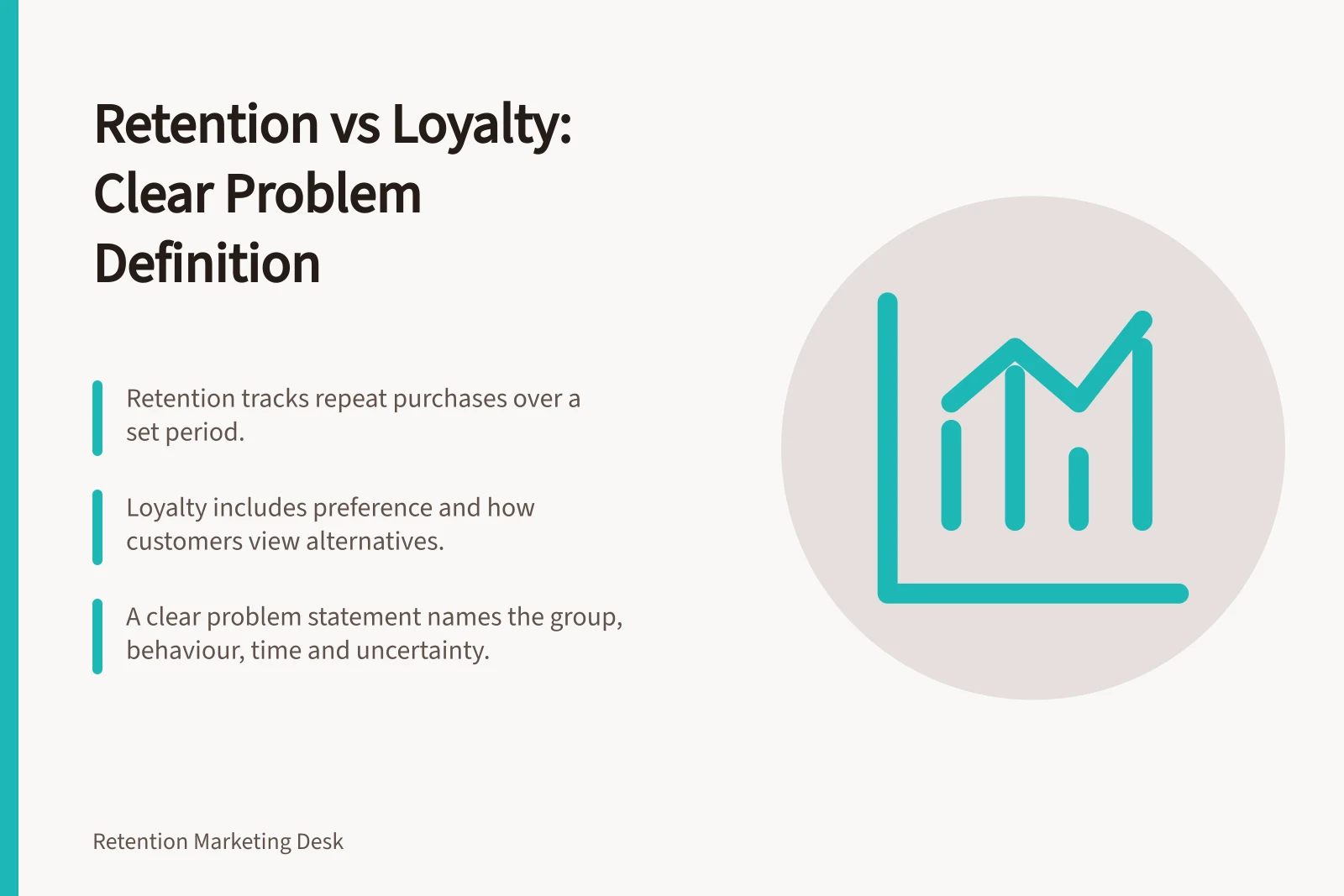
Retention measures continued purchasing over a defined period. Loyalty covers both repeat behaviour and how a customer views the business relative to alternatives. An order records a purchase; it does not by itself reveal preference. Separating the two turns a vague aim such as “improve loyalty” into a problem a team can investigate.
Retention vs Loyalty: Key Differences in Customer Behaviour
- Definition
- Continued purchasing over a defined period
- Definition
- Repeat behaviour plus positive perception relative to alternatives
- Measures
- Order frequency and timing
- Measures
- Customer sentiment, brand preference, stated intent
- Data Source
- Transaction history (e.g., Shopify reports)
- Data Source
- Surveys, feedback, NPS, focus groups
An order proves a purchase, not a preference
A customer may return because the product is convenient, the only suitable one available, part of a subscription or temporarily discounted. Another may favour the business yet buy rarely because the product lasts for years. Order history alone does not settle a customer's preference.
If fewer buyers make a second purchase after a reasonable buying opportunity, the observation concerns repeat purchasing. If repeat orders remain steady but customers report they would choose alternatives when available, there may also be a preference problem. Feedback needs neutral questions and a suitable sample; a few comments cannot represent every customer.
Limitations of Order Data Alone in Assessing Loyalty
- Pros
- Provides objective record of repeat purchases
- Cons
- Does not reveal customer preference or motivation
- Pros
- Identifies patterns in buying frequency and timing
- Cons
- Cannot confirm if choice is free or influenced by discounts/subscriptions
Write the problem as an observation
Name the group, expected behaviour, period and uncertainty. For example: “Among first-time buyers of this refill product who have had enough time to reorder, fewer made a second completed purchase than comparable earlier buyers. We do not yet know why.” This is a hypothetical problem statement, not a finding about a retailer.
“Customers are disloyal” asserts a motive that order data cannot establish. An observable statement gives the team something it can check and revise.
| What you can see | Question to ask next |
|---|---|
| Fewer qualifying second purchases | Did customers have enough time and a reason to need another purchase? |
| Regular repeat purchases | Are they choosing the business freely, and does the experience meet their expectations? |
| Positive feedback with little repeat buying | Is another purchase naturally rare for this category? |
| Purchases concentrated around offers | Would those customers buy without the offer, and what happens to contribution? |
Each pattern has several possible explanations. The questions guide investigation; the observations are not diagnoses.
How to Write a Clear Customer Problem Statement
- Identify the groupFirst-time buyers of a refill product
- Define expected behaviourSecond completed purchase within a reasonable timeframe
- State uncertaintyWe do not yet know why fewer made a second purchase
Key Observations and Next Questions for Investigation
- Fewer qualifying second purchases
- Did customers have enough time and reason to reorder?
- Regular repeat purchases
- Are customers choosing freely? Is experience meeting expectations?
- Positive feedback with little repeat buying
- Is another purchase naturally rare in this category?
- Purchases concentrated around offers
- Would customers buy without the offer? What happens to contribution?
Match the measure to the problem
For a repeat-purchase problem, define an eligible group, a qualifying next purchase and a fixed opportunity to buy again. For a preference problem, ask about relevant alternatives and reasons for choosing them. Compare answers with behaviour where possible, recognising that stated intention and a later order are different outcomes.
A loyalty scheme's membership count records program participation, not necessarily preference or repeat buying. A platform's “loyal” label may be a rule based on order recency, frequency and spending rather than a measure of attitude.
A precise statement directs the next investigation. A measurement gap calls for clearer order definitions. A recurring service complaint calls for review and repair.
Uncertainty about why customers choose the business calls for customer research. Choose a target or marketing intervention once the problem is sufficiently defined.